Our results demonstrate that the introduction of these effective seed dispersers is aiding the recovery of this critically endangered tree whose seeds were previously seed-dispersal limited. Reversible rewilding experiments such as ours are necessary to investigate whether extinct interactions can be restored.
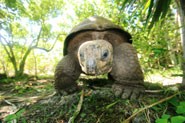
Exotic species can be used to restore important functions in ecosystems that were lost following the extinction of key species, according to a new study of giant tortoises on a small island in the Indian Ocean. The study was carried out by an international team of researchers led by the University of Bristol. 'Rewilding with taxon substitutes', the intentional introduction of exotic species to fulfil key functions in ecosystems following the loss of recently extinct species, is highly controversial, partly due to a lack of rigorous scientific studies. In a paper published today in Current Biology , Christine Griffiths of Bristol's School of Biological Sciences and colleagues present the first empirical evidence that rewilding can work. Exotic giant Aldabra tortoises, Aldabrachelys gigantea , were introduced to Ile aux Aigrettes, a 25-hectare island off Mauritius, in 2000 to disperse the slow-growing ebony Diospyros egrettarum (Ebenaceae), which once covered the island, but today is critically endangered following intensive logging for firewood that lasted until the early 1980s. To highlight the extent to which the ebony forest had been decimated, the researchers surveyed and mapped all ebony trees in an island-wide survey in 2007 and located a total of 3,518 adult trees. However, large tracts of the island remained denuded of ebony, particularly in the northern and eastern coastal areas nearest to the mainland where logging was most intense.
TO READ THIS ARTICLE, CREATE YOUR ACCOUNT
And extend your reading, free of charge and with no commitment.