The iconic Portico is beloved within our UCL community. Instantly recognisable, it is a symbol of the university’s heritage and has become synonymous with the student experience - very few leave without snapping graduation pictures in front of it.
In the 1820s, six architects submitted competing designs for the Wilkins Building. The winning entry was a grand neoclassical quadrangle with a Corinthian portico by William Wilkins - a leading architect who would design the National Gallery in Trafalgar Square.
Wilkins’s legacy extends beyond architecture, influencing generations of artists and creators.
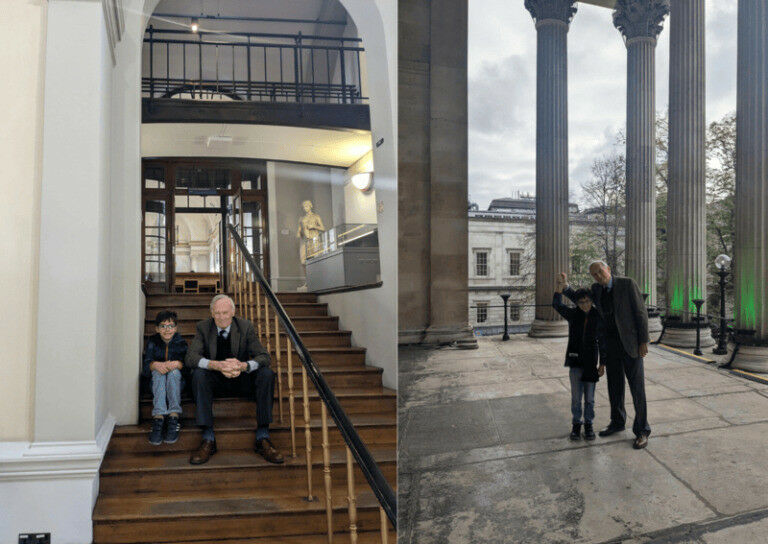
Recently, we were delighted to welcome on campus - William Wilkins, the great grandson of the architect William Wilkins, and his grandson Isaac.
Wilkins, an accomplished artist himself, was a delight to engage with, sharing fascinating architectural insights, including the often-missed boot scrapers at the base of the Portico.
He sat down with us to answer some questions, offering a personal perspective on how his ancestor’s work has influenced both his artistry and his perspective on the intersection of art, architecture, and creativity.
How did your great grandfather’s legacy nurture your interest in art and architecture?
It influenced my life hugely because I have always worked with architects, with architecture being in a sense, my second subject. I was responsible for the creation of the National Botanic Garden of Wales and commissioning Norman Foster, and I also worked with the distinguished architect Craig Hamilton.
Something I find fascinating about my ancestor’s work is his interest in horizontals and verticals and achieving a balance between them. He’s one of the least bombastic architects, often austere but very interested in the way the building relates to the landscape. For example, if you think about The Grange in Hampshire - one of his most celebrated works - its setting in the landscape is beautiful.
Is there is a reason why you only paint in situ - in the right light and in the right season - and you don’t take photographs or drawings?
That is just the way I work, which can often be extremely time-consuming. In one case, the landscape took 13 years, but it is more normal for it to be three. My use of pointillism (painting only with dots of colour) is related to my interest in ’the other,’ and therefore I look for a radiance within my paintings.
I am not overtly interested in self-expression. What truly interests me is the luminosity or radiance of ’the other’. And I think that my development of pointillism allows me to deliver this action along with a sense of the abstract, which is an integral part of painting for me.
When did you find your niche in pointillism? How did that come about?
That would be 1947. I’d been an abstract artist until around 1968 when I decided that I wanted to re-complicate my work. So, I set out to improve my drawing and I set myself a target of two years to focus only on my drawing technique, but I found it so rewarding that I ended up drawing for six years. In the meantime, I was trying to think about the kind of painting technique that would give me an equivalent delicacy and an equivalent abstraction.
If I were to contrast my work with that of my great-grandfather, he would often think in terms of form and volume, whereas I think about form and volume in simply a different way.
What would your advice be to UCL creative arts graduates?
" Don’t fuss if you feel you haven’t found your way yet. You might be phenomenally gifted and know exactly what you want to achieve but I am a firm believer in the slow development of talent.
Having worked in the arts space for so long, what do you believe is the value of arts education?
I think that there are two potential values. First, the refinement and development of the human imagination. Secondly, arts education is indispensable for the development of creativity.
In my experience at the Royal College of Art, I found that the range of businesses created by people with arts training was extraordinary.
It’s interesting to note that the Royal College also embraced elements of engineering in terms of industrial design, and that those industrial designers were mixing in the same creative spaces as the fine artists, the textile designers.
This interdisciplinary approach promotes the development of lateral thinking, and this is very valuable to a modern society.
Explore the UCL Introductory Programme
UCL has always been an institution where art, in all forms, is nurtured with many of our installations across campus being created by our alumni. The Donor Wall , on Wilkins Terrace, was created by Dr Sarah Fortais in 2019 - a graduate of the Slade School of Fine Art.As we reflect on this rich heritage, we invite you to explore how our past continues to inspire our future. What makes the Portico so remarkable? Is it the design, the symbolism, or the way it connects the past with the present?
The UCL Introductory Programme is an interactive course designed to help you learn about our past, present and future. You’ll have the chance to decide for yourself: Do you agree with the founders’ choice of neoclassical design, or would you have taken a different approach?
2026 is also our Bicentenary - when UCL turns 200 since our establishment as the first university in London. We have an exciting year of celebration and activity planned. You can find out more about the Bicentennial celebrations here.
- University College London, Gower Street, London, WC1E 6BT (0) 20 7679 2000