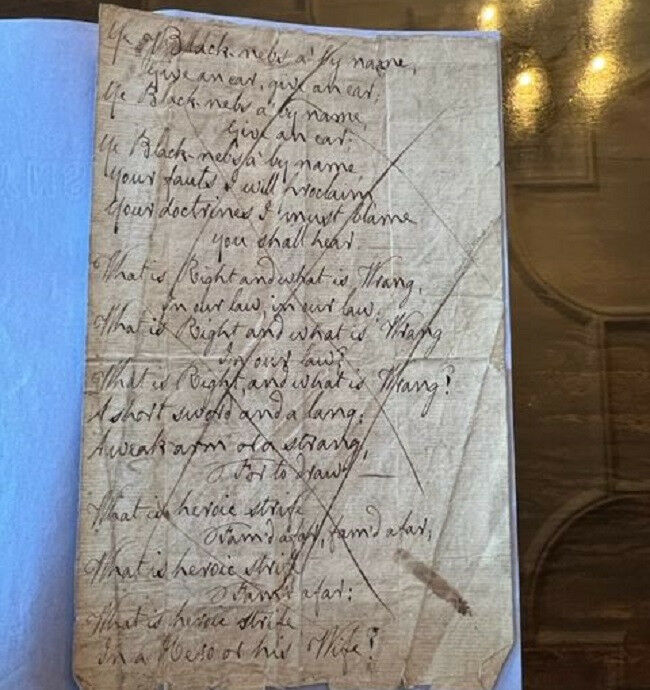
Page 1 of the cancelled manuscript of Ye Jacobites by Name in the handwriting of Robert Burns was discovered in the collection of Burns materials held at Barnbougle Castle, near Edinburgh. Photo by Dr Pauline Mackay (by permission Dalmeny Estate Collections)
Page 1 of the cancelled manuscript of Ye Jacobites by Name in the handwriting of Robert Burns was discovered in the collection of Burns materials held at Barnbougle Castle, near Edinburgh. Photo by Dr Pauline Mackay (by permission Dalmeny Estate Collections) The cancelled working manuscript of the song - Ye Jacobites by Name - was written by Burns in 1791 in the inflammatory early period of the French Revolution, against which reformers in the British Isles increasingly agitated for political change. Robert Burns wrote about revolutionary themes that if published might have placed him under suspicion with the authorities. The discovery of a cancelled manuscript by Burns, an early version of one of his most famous songs, is the most explicit instance of several where he ostensibly writes about history but actually has his eye on 18 century current affairs following the French Revolution. The finding by a leading Burns expert based at the University of Glasgow is of another version of Burns' song, 'Ye Jacobites by Name'. The cancelled working manuscript of the song was written by Burns in 1791 in the inflammatory early period of the French Revolution, against which reformers in the British Isles increasingly agitated for political change. While today Burns is a world-renowned poet and songwriter, he lived a life in which he had no political vote, even as a highly skilled Exciseman working for the very government that denied him that right.
TO READ THIS ARTICLE, CREATE YOUR ACCOUNT
And extend your reading, free of charge and with no commitment.