


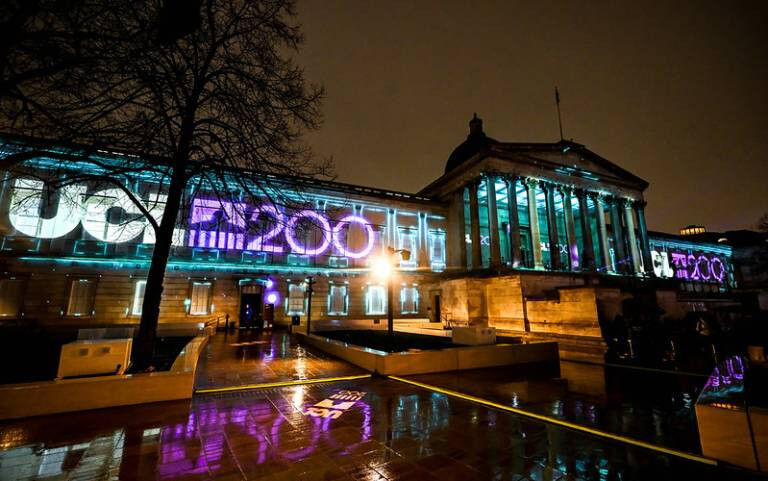
On 11th February 1826, a group of visionary intellectuals came together to establish a new type of university. Inspired by the radical ideas of philosopher Jeremy Bentham, the self-styled ’London University’ modelled itself as an affordable, modern alternative to the ancient Universities of Oxford and Cambridge. In 1828, it opened its doors to its first students and the rest is history.
In the following two centuries, UCL broke down educational barriers, nurtured some of history’s greatest minds and transformed countless lives through scientific breakthroughs.
Throughout 2026 - this landmark year - UCL will celebrate its bicentenary with an exciting UCL200 programme of events, exhibitions, lectures and festivals.
For 200 years, history has happened here. We can’t wait to see what happens next.
UCL President and Provost, Dr Michael Spence said: "When our founders established UCL 200 years ago, they had a radical vision for a new kind of university, one that was focused not only on expanding knowledge but on putting that knowledge to work for the public good, and open to all regardless of faith or background. That founding ethos has always been fundamental to UCL’s sense of who we are and what we are here to do."Two hundred years later, we have grown into one of the world’s leading universities: solutions-focused, agile and innovative, and working in partnership with people and societies locally, nationally and globally to improve lives.
"Now, in a complex, fast-changing and unpredictable global landscape, the appetite of our community to continue to fulfil our founding philosophy is a strong as ever. For two centuries, UCL has challenged conventional thinking and pushed the boundaries of what a university can be.
"As we enter our third century, I am hugely confident that the creativity, ambition, resilience and generosity of all who work at UCL will play a key part in shaping a better future for us all."
Professor Dame Hazel Genn, Pro-Provost Bicentennial, said: "UCL continues to be a place of brave ideas and extraordinary opportunity. The year ahead will be a celebration of UCL’s founding values, achievements and impact, and provide an opportunity to look to the future and ensure we continue to shape a better world."
UCL Illuminated
Kicking the festivities off, UCL Illuminated will make the newly remodelled Quad and Wilkins building dazzle through an immersive sound and light extravaganza. The iconic buildings will be brought to life with cutting-edge 3D projection mapping, light, music, storytelling and animation.The sold-out shows, which run on the evenings of 11, 12 and 13 February 2026, will chronicle UCL’s path from a small community of visionaries on the city’s edge to a global force for learning, research, creativity and innovation.
A free online stream of UCL Illuminated is available for those unable to join us in person. Book your ticket today to join the celebration.
Two Centuries Here exhibition
A major new exhibition opens on UCL’s Bloomsbury campus today. Spanning the North and South Cloisters, the Octagon Gallery, Japanese Garden and the Student Centre, Two Centuries Here explores UCL’s past, present and future.The free exhibition considers UCL’s progressive origins, far-reaching impact, global community and vibrant future through photography, objects, artefacts, stories, dialogue, and interactive experiences.
See the Crookes tube that led to the UK’s first clinical X-ray, a rocket nose cone linked to UCL’s Mullard Space Science Laboratory, ancient Egyptian objects bequeathed to the university by writer Amelia Edwards, and much more.
Students’ Union UCL celebrates
There is no university without its students, and throughout 2026 Students’ Union UCL have put together a packed schedule of ways to mark this special year.In June, the Students’ Union will host the UCL200 Summer Festival and the artsUCL Fringe Festival. The campus will be transformed into a festival site for the biggest and most exciting events in SU history. Sign up to the UCL200 Summer Festival mailing list to hear updates.
Also in June, the artsUCL Fringe Festival will bring campus to life with theatre, comedy, dance, cabaret, music, drag, stand-up, musical theatre, and everything in between. Applications for the artsUCL Fringe Festival are now open.
A series of society performances, workshops, food festivals, and talks will display UCL’s cultural diversity at UCL’s International Festival , taking place from 23 -26 February 2026, and the UCL Campus run will return in April at the iconic Queen Elizabeth Olympic Park.
Find out more about Students’ Union UCL’s bicentenary celebrations.
New publications
Student London: The untold history of student life in the UK’s capital city
Drawing on a huge range of source material, from college magazines and newspapers to student memoirs, diaries and letters, Student London: A New History of Higher Education in the Capital explores student life, not just at the original ’London University’, but at the many formerly independent higher education institutions that later merged with UCL.Written and researched by Professor Georgina Brewis and Dr Sam Blaxland (UCL Institute of Education), Student London engages in much greater depth with London’s imperial history than earlier studies, exploring the significance of international students and presenting an authentic story of diverse student experiences in London across two centuries.
This book is the outcome of a research and engagement project called Generation UCL: Two Hundred Years of Student Life in London, conducted in partnership with the Office of the Vice President (Advancement) and Students’ Union UCL.
Student London is now available to purchase online or in person at The Hanger.
Survey of London: An architectural history of UCL’s Bloomsbury campus
A special volume of the renowned architectural series, Survey of London, will offer the first comprehensive account of the UCL’s buildings and the evolution of the historic Bloomsbury campus.The book charts the evolution of UCL’s architecture from Greek Revival classicism, through Victorian experimentation and inter-war Neo-Georgian, to post-war Brutalism and to the high-tech, energy efficient and adaptable buildings expected of a modern university today.
An architectural history of UCL’s Bloomsbury campus was researched and written by Director of the Survey of London, Colin Thom and Dr Amy Spencer (both UCL Bartlett School of Architecture). It is available to purchase online or at The Hanger.
UCL at 200: Two centuries of insight and impact
UCL at 200 is a commemorative volume that celebrates and reflects on the university’s past and present, bringing together more than 100 contributors to recognise its achievements, challenges, and enduring spirit. Through personal recollections, scholarly reflections, and rich archival and contemporary visuals, it offers insight into an institution defined by free thinking, a willingness to challenge the status quo, and a drive to push beyond traditional research boundaries for global benefit. As UCL enters its third century, the book highlights the values that have shaped it since 1826 and shows what is possible when academics, partners and communities work together to ensure research reaches those who need it most.UCL at 200: Two centuries of insight and impact, is edited by Professor Virginia Mantouvalou (UCL Faculty of Laws). It is available to purchase online or at The Hanger.
Public art
As UCL enters its 200th year, a varied public art programme has been announced, comprising of a Legacy Commission, an Artist-in-Residence Programme and a UCL Staff Commission. Find out more about the artists and their projects.Get involved
’Here, it will happen’ philanthropic campaign
UCL has launched Here, it will happen, a new philanthropic and engagement campaign that sets out our ambitions to solve global health, societal, climate and education challenges in our institution’s next century. Here, it will happen is our invitation to the global UCL community to stand with us and ensure these ambitions are met.UCL200 merchandise
Limited-edition UCL200 merchandise is now available exclusively at The Hanger. Featuring everything from lanyards, pin badges and tote bags to a premium UCL200 decanter set, there is something for everyone.UCL200: From breaking barriers to global top 10 world university
In the last two centuries, UCL has broken down educational barriers, becoming the first university to admit students regardless of faith and the first to admit women into higher education alongside men. UCL has since nurtured some of history’s greatest minds, including 33 Nobel Prize winners, and transformed countless lives through scientific breakthroughs.Our students benefit from a rich, interdisciplinary education - and have done from our early days - and we were one of the first universities to offer subjects such as English, Italian, German, Spanish, Physiology, Chemistry, Law, Geography, Mathematics and Engineering.
And in 2023, UCL East was officially opened on Queen Elizabeth Olympic Park, in Stratford, east London - marking the university’s largest expansion since its founding.
With a cross-disciplinary approach, UCL researchers address the world’s greatest global challenges, such as climate change, food security, mental health and space exploration, while also accelerating breakthroughs in robotics, AI, fair finance, sustainable cities, and assistive technology.
UCL scientists have pioneered the development of new treatments and diagnostics for Alzheimer’s disease , prostate cancer and Huntington’s disease.
We are also home to the internationally recognised Slade School of Fine Art, whose alumni include Rachel Whiteread, the first woman to win the Turner Prize, and the UCL Bartlett School of Architecture, where the term ’gentrification’ was coined by Ruth Glass in 1964, and the UCL Institute of Education, which has topped the world subject rankings for the past 12 years.
And UCL academia has real-world impact, by informing legislation like the Online Safety Bill , or by commercialising research into one of UCLB’s hundreds of startups and spinout businesses, creating thousands of jobs and bringing investment worth millions into the UK.
In 2026, UCL shows no signs of slowing down. Today, it is a European top three and a global top ten university , home to a diverse, dynamic student body of 51,793 students and a global community of 465,000 alumni across 190 countries. It is ranked first in the UK and third in the world for sustainability.
Each year, UCL trains the doctors, teachers, engineers, lawyers and architects of tomorrow. Independent analysis by London Economics also shows UCL generates around £10bn annually of economic impact across the UK. This includes our research: for every £1m of publicly funded research income, the university produces £11.5m in economic return.
Sophie Hunter
T: +44 (0)7747 565 056E: sophie.hunter@ucl.ac.uk
- University College London, Gower Street, London, WC1E 6BT (0) 20 7679 2000