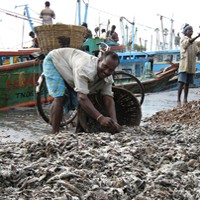
Once largely discarded by trawlers, the low value bycatch is increasingly being landed through most of the developing world and is now processed to fishmeal to supply the region's growing poultry and aquaculture industry
Fishermen barely eking out a profit because of overfishing of their target stock, shrimp, are now surviving by selling their bycatch (the low-value fish also caught in the large, indiscriminate nets). Although good for the fishermen, scientists warn that the prolonged trawl fishing along certain areas will lead to an 'ecological catastrophe' and the 'permanent loss of livelihoods for fishers' as well as other individuals who work in the industry. A paper published in the current issue of the journal Conservation Letters by researchers from the University of Cambridge shows that the drivers for the use of this once discarded resource are twofold: declining shrimp stocks and profits, and the development of alternative markets, which include the rapidly growing poultry-feed industry. Trawl fishing is a technique employed the world over in which a fishing vessel drags a gaping net along the ocean floor. Unfortunately, though trawlers target a limited number of species such as shrimp and some fish, trawl nets capture anything in their path and seriously damage the seafloor as well. It's been estimated that trawlers in the tropics capture an average of 10 kilos of bycatch for every kilo of shrimp. When trawl fishing first began in South and Southeast Asia, trawlers discarded large quantities of bycatch.
TO READ THIS ARTICLE, CREATE YOUR ACCOUNT
And extend your reading, free of charge and with no commitment.