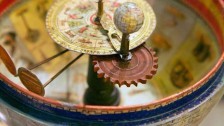
Globe c. 1907 Credit: Whipple Museum (photographer: Jacqueline Garget)
The planetarium is sized to fit a child's hand, with instructions designed to be read aloud." - —Seb Falk Object Wh.5892 in the University's Whipple Museum of the History of Science is something of an enigma. Clearly it's a globe, but lift the northern hemisphere and you enter a startling world: volcanoes erupt, a mammoth lifts its tusks, dinosaurs clash. And amid these beautiful illustrations and encyclopaedic entries, a planetarium lies ready to re-enact the revolution of the planets around the sun at the turn of a cog. The Spanish globe, unlike any currently known, has been shrouded in mystery: where, when and why was it made? Who would have used it? Most fundamentally, what is it - some kind of scientific instrument or a child's toy? Now, research by Seb Falk in the Department of History and Philosophy of Science has brought us closer to understanding the puzzling object, which is 25 cm in diameter. Remarkably, his work highlights how it symbolises a wave of change that swept 19th-century Spain into the modern world - from increasing trade in scientific instrumentation to a move of the education system towards interactive learning. "Making a globe like this would have been technically difficult: apart from the construction of the globe from brass, wood and pasteboard, the inside of the sphere is hand-covered with encyclopaedic information designed expressly for the object and printed using the latest chromolithographic technology.
TO READ THIS ARTICLE, CREATE YOUR ACCOUNT
And extend your reading, free of charge and with no commitment.