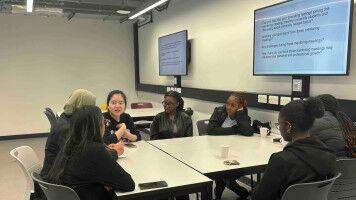
Dozens of aspiring UCL students joined the second iteration of the India Summer School at The British School New Delhi.
The 72 teenagers, from across India, joined six interdisciplinary pathways that offered a taste of what it’s like to study at UCL, led by top academics during the event from 2-7 June.
This year the UCL India Summer School also took in its first scholarship student, in collaboration with the United Nations High Commissioner for Refugees (UNHCR).
Following the culmination of the summer school programme on 7 June, the academics welcomed more than 40 UCL alumni who joined them for a special reception at the British Council in New Delhi.
UCL Vice-President of Operations, Aimie Chapple, who was guest of honour at the Summer School said: "It has been a delight to bring our accomplished academics, students, and fantastic alumni together to give a week-long taste of UCL to talented pre-university Indian students. As we prepare to celebrate our bicentennial in 2026, we look forward to returning to The British School for the third year of this inspirational programme."
The immersive academic programme provided students with a unique opportunity to engage UCL’s world-class education and interdisciplinary learning.
Alongside seminar-based work on topics ranging from Economic History to Medical Sciences and AI, Dr Michael Collins (UCL History), director of the UCL India Summer School, led sessions on ’Interdisciplinarity’ and ’Disagreeing Well in Higher Education’.
Building on the success of the inaugural Summer School last year, the week featured a dynamic blend of lecture-style classes, hands-on workshops, and student-led discussions, encouraging participants to think critically and apply their knowledge to real-world challenges.
Students selected from six specialised pathways delivered by leading UCL experts:
- Globalisation and Technology (Dr Alka Raman, UCL History)
- Law and Ethics (Dr Isra Black, UCL Laws)
- Economics and Health (Professor Jolene Skordis, UCL Institute for Global Health)
- Climate Change and the Future City (Professor Priti Parikh, UCL Bartlett School of Sustainable Construction)
- Understanding the Human Brain (Professor James Kilner, UCL Institute of Neurology)
- Medical Sciences and AI (Professor Darren Player, UCL Surgery and Interventional Science)
With class sizes capped at 12, students benefited from personalised teaching and direct engagement with UCL faculty. Each day concluded with plenary sessions covering topics such as career development, academic practices, and the UK university application process, offering invaluable insights beyond the classroom.
The programme culminated in a valedictory ceremony, where students presented their group projects and received certificates in the presence of their families, professors, and school leadership.
Dr Michael Collins said: "The UCL India Summer School is part of our wider strategic partnership with India, a catalyst for enhanced co-operation between UCL academics, alumni operations, and global engagement partners. It’s a vision built on shared learning and co-curation, providing opportunities for the very best India students to study in the UK whilst developing our understanding of how UCL can learn from and contribute to India’s future growth."
Vanita Uppal OBE, Director of The British School New Delhi, added: "It is always a pleasure to collaborate with UCL and their excellent team of professors. This programme exemplifies our commitment to providing students with transformative educational experiences that train minds to apply academic insights to real-world applications. By immersing them in rigorous academic pathways and fostering critical thinking, we aim to inspire the next generation of leaders and innovators."
UCL has a thriving alumni community in India, with more than 4,340 graduates across the country representing a wide range of disciplines, from management and law to architecture. Alumni groups in Delhi, Mumbai and Bengaluru organise a varied calendar of educational and social events throughout the year to keep alumni connected.
The UCL alumni reception opened with remarks from Michael Houlgate, Deputy Director India at the British Council, followed by speeches from UCL leaders highlighting the latest university developments. These include plans to celebrate UCL’s bicentennial in 2026 and launch the university’s next major philanthropic and engagement campaign.
UCL also continues to have strong ongoing partnerships and new opportunities in both education and research in India. Later this month, leading UCL academics will visit partners in Bengaluru and Mumbai to explore opportunities for collaboration in the field of quantum technologies. They will visit The Indian Institute of Science and Raman Research Institute in Bengaluru, and the Indian Institute of Technology and Tata Institute of Fundamental Research in Mumbai.
- University College London, Gower Street, London, WC1E 6BT (0) 20 7679 2000