Starburst Galaxy by ESA-C. Carreau. Artist’s
impression of starburst galaxy HFLS3.
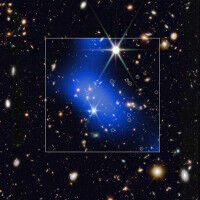
A team including Dr Mat Page (UCL Space and Climate Physics) has discovered an extremely distant galaxy making stars more than 2000 times faster than our own Milky Way. Seen at a time when the Universe was less than a billion years old, its mere existence challenges our theories of galaxy evolution. The observations were carried out using the European Space Agency's Herschel Space Observatory. The galaxy, known as HFLS3, appears as little more than a faint, red smudge in images from the Herschel Multi-tiered Extragalactic Survey (HerMES). Yet appearances can be deceiving: this small smudge is actually a star-building factory, furiously transforming gas and dust into new stars. Our own Milky Way makes stars at a rate equivalent to one solar mass per year, but HFLS3 is seen to be churning out new stars at more than two thousand times more rapidly. This is one of the highest star formation rates ever seen in any galaxy.
TO READ THIS ARTICLE, CREATE YOUR ACCOUNT
And extend your reading, free of charge and with no commitment.