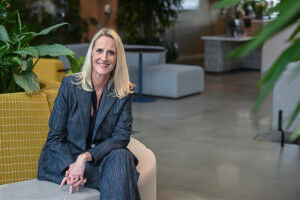
Katie Gaddini, Associate Professor of Sociology, explores the lives and politics of right-wing Christian women in America. A UKRI Research Fellow at Stanford and former social worker, she brings a global, human perspective to women’s roles in society.
What is your role and what does it involve?
I am Associate Professor of Sociology in the Thomas Coram Research Unit within the Social Research Institute. Since 2022, I have been a UKRI research fellow based at the History Department, Stanford University. This is my final year of the fellowship and my ’re-integration’ back at UCL, where I will transfer knowledge gained at Stanford to my home department.
How long have you been at UCL and what was your previous role?
I was hired in autumn 2019 as a Senior Teaching Fellow, though it was a maternity cover for a colleague. My role was made permanent the following year, thanks to the insistence of my former head of unit, Margaret O’Brien. In 2023 I was promoted to Associate Professor and switched from the teaching track to the research and teaching academic track. Before UCL, I spent one year as a postdoc at the University of Cambridge, where I also completed my PhD.
What working achievement or initiative are you most proud of?
As I conclude my study on right-wing Christian women in America, I am incredibly proud (and a bit relieved) that I pulled it off. I faced a lot of obstacles since I started this research in August 2016. First was access, as many conservatives would not speak with me, a scholar who is part of what the right considers the ’liberal elite’ under Trump’s America. Then, in 2020, the pandemic forced me to move my interviews online and on the phone which presented other problems as my interlocutors were very suspicious of government tracking via phones and video calls. When I finally managed to resume in-person ethnography in 2022, I again faced challenges accessing participants, as so many Americans were wary from the rancorous political climate of the previous six years. The final hurdle was writing my book: I was so pleased to be offered a book contract with a prestigious trade press, but they asked for a very tight deadline - just 6 months! - to submit the manuscript. Writing a 50,000-word book on US politics, while also living through a volatile political environment and raising a toddler was no easy feat.
Tell us about a project you are working on now which is top of your to-do list
I’m preparing for my book to come out in June 2026, including organizing a book tour and publicity activities. I am also starting to think ahead to future projects. It’s clear that the right and far-right are in ascendance in many parts of the world, including the UK. In order to better understand why women globally are drawn to and instrumental to these movements, we need international, cross-disciplinary, in-depth research.
What is your favourite album, film and novel?
One of my all-time favourite novels is The God of Small Things by Arundhati Roy and I love Ondara’s Tales of America album, which my husband and I played at our register office marriage ceremony. I watch a lot of films, so it’s impossible to name just one favourite, but a few nights ago I saw It Was Just an Accident, by Jafar Panahi and was blown away. It’s brilliant.
What is your favourite joke (pre-watershed)?
I’m not sure I have one!
Who would be your dream dinner guests?
I’d love to bring together feminists from different periods in history and from around the world, to learn from thinkers such as Silvia Federici, bell hooks, Gloria Anzaldúa, Maria Antonietta Macciocchi, Judith Butler, Pumla Gqola, and others.
What advice would you give your younger self?
Go with the flow and stop trying to micromanage everything. I had so many junctures in my twenties and thirties where I thought my career was going off the deep end, or my plans were being irrevocably foiled. But then another opportunity would arise and usually an even better path would be taken. In fact, right before I got my job at UCL, I applied and interviewed for what I thought was my dream job at a different university (I won’t say which!). I was deeply disappointed when I didn’t get the job. Looking back, I’m so grateful I didn’t, as I couldn’t imagine a better home institution or colleagues than the ones I have now at UCL.
What would it surprise people to know about you?
Academia is actually my second career. I used to be a social worker, focussed on gender-based violence, in Boston, Johannesburg, and then Madrid, before I decided to change tactics and pursue academia.
What is your favourite place?
The outskirts of Lucca, Italy. I have relatives there, on my father’s side, and try to visit them every year. Riding a bicycle past vineyards and cypress trees, surrounded by Tuscan hills, brings me more joy than any other place in the world.
- University College London, Gower Street, London, WC1E 6BT (0) 20 7679 2000