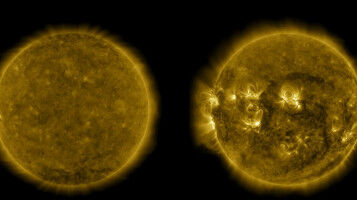
The Sun as seen by Solar Orbiter in extreme ultraviolet light from a distance of roughly 75 million kilometres. In total, the final image contains more than 83 million pixels, making it the highest resolution image of the Sun’s full disc and outer corona
The Sun as seen by Solar Orbiter in extreme ultraviolet light from a distance of roughly 75 million kilometres. In total, the final image contains more than 83 million pixels, making it the highest resolution image of the Sun's full disc and outer corona - The Sub-observing Solar Orbiter spacecraft, which carries instruments proposed, designed and built at UCL, has spotted a "tube" of cooler atmospheric gases snaking its way through the Sun's magnetic field. The observation provides an intriguing new addition to the zoo of features revealed by the European Space Agency-led mission, especially since the snake was a precursor to a much larger eruption. The investigation into the phenomenon is being led by Dr David Long (UCL Mullard Space Science Laboratory), who co-leads the science team for the Extreme Ultraviolet Imager (EUI) onboard the spacecraft. The snake was seen on 5 September 2022, as Solar Orbiter was approaching the Sun for a close pass that took place on 12 October. It is a tube of cool plasma suspended by magnetic fields in the hotter surrounding plasma of the Sun's atmosphere. Plasma is a state of matter in which a gas is so hot that its atoms begin to lose some of their outer particles, called electrons.
TO READ THIS ARTICLE, CREATE YOUR ACCOUNT
And extend your reading, free of charge and with no commitment.