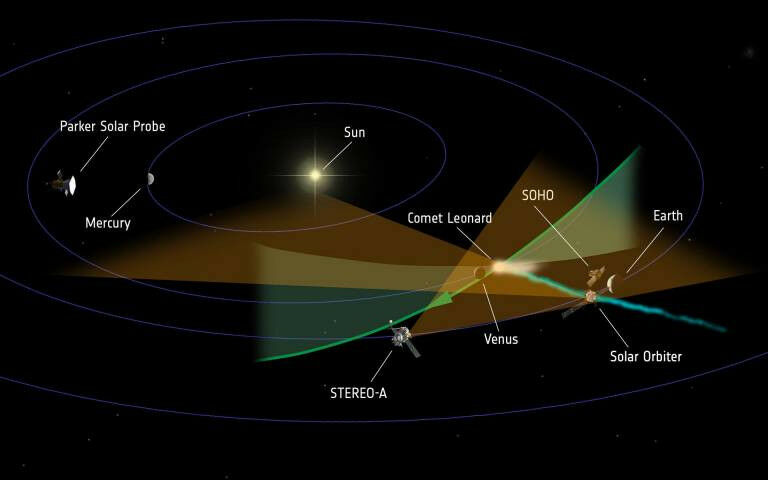
. The graphic shows the approximate relative positions of the planets, comet and spacecraft on 17 December 2021
. The graphic shows the approximate relative positions of the planets, comet and spacecraft on 17 December 2021 - For the second time in its mission so far, the Sun-observing spacecraft Solar Orbiter has flown through the tail of a comet, generating a wealth of science data - helped by an early prediction of the event by a UCL PhD researcher. For several days in mid-December, the European Space Agency (ESA) spacecraft - which carries instruments designed and built at UCL - found itself flying through the ion tail of Comet C/2021 A1 Leonard, analysing particles from the comet and the way its tail interacted with the solar wind. The crossing had been predicted by Samuel Grant, a research student at the Mullard Space Science Laboratory at UCL. He adapted an existing computer program, developed by Professor Geraint Jones (UCL Mullard Space Science Laboratory), that compared spacecraft orbits with comet orbits to include the effects of the solar wind and its ability to shape a comet's tail. (Both researchers are also affiliated with the Centre for Planetary Sciences at UCL/Birkbeck. Grant said: "I ran it with Comet Leonard and Solar Orbiter with a few guesses for the speed of the solar wind.
TO READ THIS ARTICLE, CREATE YOUR ACCOUNT
And extend your reading, free of charge and with no commitment.