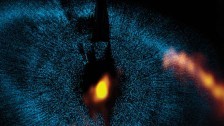
Dust ring around the star Fomalhaut taken by ALMA Credit: ESO/NAOJ/NRAO/NASA/ESA/Hubble Space Telescope
We'll be able to look for evidence of unintentional radio emissions, the equivalent of airport radar, from our nearby stars and planetary systems that may indicate intelligent life." - How do planetary systems form? What do the surfaces of stars look like? Does life exist elsewhere in the Universe? Astronomers have developed many theoretical models, but until now the ability to validate these with observations has been severely constrained by the telescope capabilities available. Taking the lead in three major new international projects, Cambridge astronomers are tackling the enormous technical challenges involved in developing bigger and better telescopes to open new windows onto the Universe. Building on Cambridge's strong legacy of achievement in astronomical instrumentation, the new telescopes all utilise one important underlying technique -interferometry by aperture synthesis - to probe the Universe at a level of detail far beyond the capabilities of any telescope currently in existence. Each telescope will detect light at a different wavelength and help to build a fuller picture of exactly what is out there. "When we look at regions of star formation with the best existing high-frequency radio telescope, we see blobs. We can learn a lot by looking at the radio waves that come out of these, but inside there will be all sorts of complicated structures that the telescope can't resolve," said John Richer, astrophysicist at the Cavendish Laboratory and the Kavli Institute for Cosmology.
TO READ THIS ARTICLE, CREATE YOUR ACCOUNT
And extend your reading, free of charge and with no commitment.