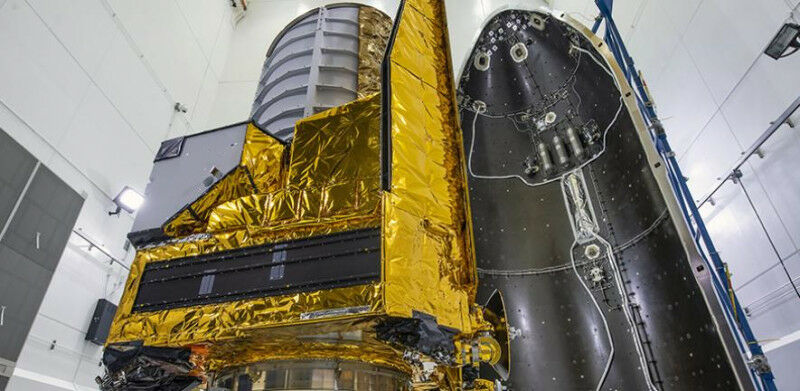
Last glimpse of Euclid on Earth Credit: ESA
A European mission to explore how gravity, dark energy and dark matter shaped the evolution of the Universe soared into space today from Cape Canaveral. Last glimpse of Euclid on Earth Credit: ESA The Euclid mission will finally uncover the mysteries of how these -dark- forces have shaped the cosmos that we see today, from life here on Earth, to our Sun, our Milky Way, our nearby galaxy neighbours, and the wider Universe beyond Nicholas Walton The Euclid space telescope will map the -dark Universe- by observing billions of galaxies out to 10 billion light-years, across more than a third of the sky, to gather data on how its structure has formed over its cosmic history. Led by the European Space Agency (ESA) and a consortium of 2,000 scientists, including from the University of Cambridge, Euclid will spend six years venturing through space with two scientific instruments: a UK-built visible imager (VIS) that will become one of the largest cameras ever sent into space, and a near infrared spectrometer and photometer, developed in France. The mission is supported by funding from the UK Space Agency. -Watching the launch of Euclid, I feel inspired by the years of hard work from thousands of people that go into space science missions, and the fundamental importance of discovery - how we set out to understand and explore the Universe,- said Chief Executive of the UK Space Agency, Dr Paul Bate. -The UK Space Agency's investment in Euclid has supported world-class science on this journey, from the development of the ground segment to the build of the crucial visible imager instrument, which will help humanity begin to uncover the mysteries of dark matter and dark energy.
TO READ THIS ARTICLE, CREATE YOUR ACCOUNT
And extend your reading, free of charge and with no commitment.