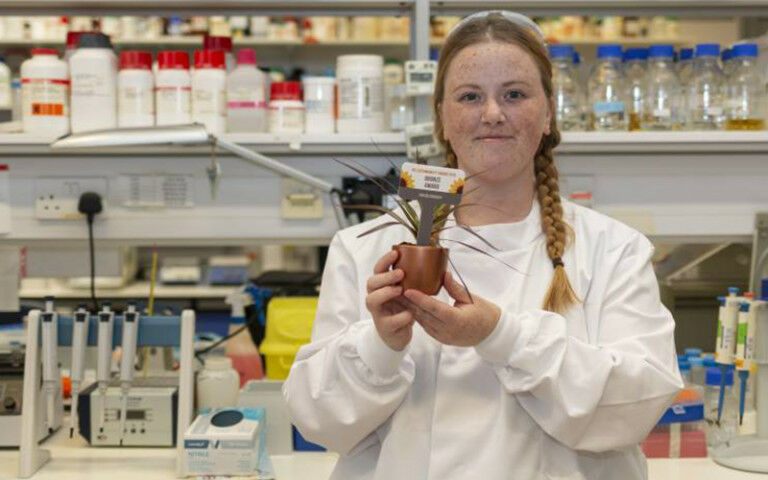
An image of a women holding up a LEAF bronze award - Credit: LEAF
An image of a women holding up a LEAF bronze award - Credit: LEAF - The Medical Research Council (MRC) has signed up to the UCL-developed tool LEAF - Lab Efficient Assessment Framework - to help lab-based scientists reduce their carbon emissions and support the transition to net zero. Created by Sustainable UCL in 2018, LEAF enables scientists to lower their emissions by making changes to the way they work, use laboratory equipment and consume resources. The framework contains actions that lab users can take to save plastics, water, energy and other resources, and are proven to be effective without detrimental impact on the quality or progress of the science. Joanna Marshall-Cook ( Senior Sustainability Manager , Sustainable UCL) said: "The science tells us that time is short to avoid planetary chaos and we need to work fast to cut our carbon emissions. LEAF is helping to accelerate the move to sustainable science in the UK and internationally by ensuring the research community is at the forefront of sustainable laboratory practice." Martin Farley (Sustainable Labs Advisor, Sustainable UCL) added: "It's been incredibly motivating to see the sector's reception of LEAF. We're excited to continue working with the scientific community to meet the challenges posed by climate change." Currently research in bio and life sciences laboratories uses huge amounts of energy, chemicals and resources, and laboratories often consume three to 10 times more energy than typical non-lab areas of universities.
TO READ THIS ARTICLE, CREATE YOUR ACCOUNT
And extend your reading, free of charge and with no commitment.