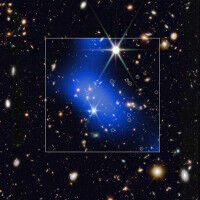
An image of the star Gilese 581 (bottom of image), with an illustration of the debris disc superimposed to show its position. Credit: ESA.
Material in the debris disc is a fossil from the epoch of planet formation so it may carry information about the processes that contributed to build up the planetary system." - —Mark Wyatt Astronomers have detected massive debris discs around 61 Virginis and Gilese 581, two nearby stars that are known to host "super-Earth" planets - so-called because their mass is between that of Earth and Neptune. Debris discs are belts of comets and asteroids orbiting the star. The study, which was carried out using the European Space Agency's Herschel Space Observatory, also reveals that debris discs are preferentially found in planetary systems with low-mass planets than in those hosting high-mass planets. This suggests that debris discs may survive more easily in the absence of planets with a very high mass, and highlights the importance of debris discs in the study of planet formation. The formation of planets, around a newly-born star, is a dynamic process than can last hundreds of millions of years. Debris discs are a by-product of the process.
TO READ THIS ARTICLE, CREATE YOUR ACCOUNT
And extend your reading, free of charge and with no commitment.