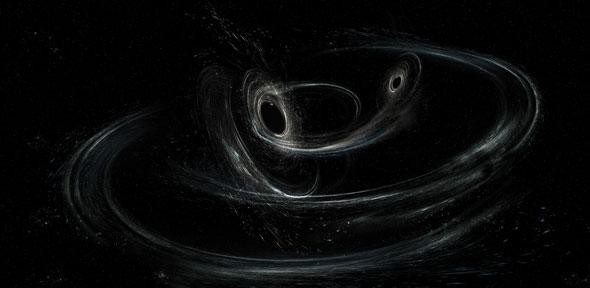
Artist's conception shows two merging black holes similar to those detected by LIGO.
Credit: LIGO/Caltech/MIT/Sonoma State (Aurore Simonnet)
Each new detection enables us to explore new phenomena of these mysterious and fascinating objects. Ulrich Sperhake The Laser Interferometer Gravitational-wave Observatory (LIGO) has made a third detection of gravitational waves, ripples in space and time, demonstrating that a new window in astronomy has been firmly opened. As was the case with the first two detections, the waves were generated when two black holes collided to form a larger black hole. The newfound black hole formed by the merger has a mass about 49 times that of our sun. 'With this third confirmed detection we are uncovering the population of black holes in the Universe for the first time,' said Christopher Moore from the University of Cambridge's Department of Applied Mathematics and Theoretical Physics (DAMTP), who is part of the LIGO Scientific Collaboration. The new detection occurred during LIGO's current observing run, which began November 30, 2016, and will continue through the summer. LIGO is an international collaboration with members around the globe.
TO READ THIS ARTICLE, CREATE YOUR ACCOUNT
And extend your reading, free of charge and with no commitment.