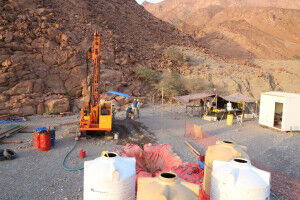
PanCam Prototype. Credit: AMASE
This week saw the most ambitious test yet of the European Space Agency's ExoMars Rover, when - remotely controlled by scientists the UK - it explored the Atacama Desert in South America. The panoramic camera onboard ExoMars, called PanCam, is led by scientists at the UCL Mullard Space Science Laboratory (MSSL) and provides stereo and high resolution imagery of the terrain around the Rover. This week, at the Sample Acquisition Field Experiment with a Rover (SAFER) field trial, the PanCam team had the chance to test their instrument in the desolate Atacama Desert in northern Chile, which is one of the closest terrestrial matches for Mars. An early ExoMars prototype rover called Bridget, which has been provided by UK company Astrium, is being used for the trial. During the test, Dr Andrew Griffiths and Professor Andrew Coates from UCL MSSL, along with Aberystwyth PanCam team members, have been in the ExoMars remote control centre based at the Satellite Applications Catapult facility in Harwell, UK. The PanCam team is an international one, involving Germany, Switzerland, Austria and the UK. One of the most important elements of the week has been to work with some of the other 'context' instruments - the close up imager and the ground penetrating radar (WISDOM).
TO READ THIS ARTICLE, CREATE YOUR ACCOUNT
And extend your reading, free of charge and with no commitment.