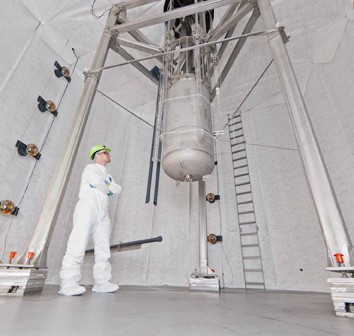
University of California, Davis, physicist Jeremy Mock inspects the LUX detector. The cylinder in the center resides inside a protective water tank, which now has been filled with ultra-pure water. Credit: Matt Kapust/Sanford Lab
An experiment to look for one of nature's most elusive subatomic particles is finally under water, in a stainless steel tank nearly a mile underground beneath the Black Hills of South Dakota. The Large Underground Xenon experiment, nicknamed LUX, will be the most sensitive device yet to look for dark matter. Thought to comprise more than 80 percent of the mass of the universe, dark matter has so far eluded direct detection. The LUX detector, under construction for more than three years in South Dakota, was installed underground in a protective tank in July. The tank was filled with water last week, and all systems are functioning well. Chamkaur Ghag (UCL Physics & Astronomy), a recent appointment in the High Energy Physics Group, leads the UCL activity in the experiment which is now installed deep underground in a former gold mine. He said: "The LUX detector will be the most advanced instrument yet in the worldwide hunt for the missing mass of the Universe, known as 'dark matter'.
TO READ THIS ARTICLE, CREATE YOUR ACCOUNT
And extend your reading, free of charge and with no commitment.