Big, spinning black hole blurs light
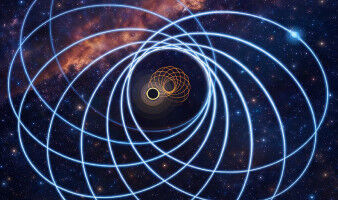
NASA's Nuclear Spectroscopic Telescope Array (NuSTAR) has captured an extreme and rare event in the regions immediately surrounding a supermassive black hole. A compact source of x-rays that sits near the black hole, called the corona, has moved closer to the black hole over a period of just days. "The corona recently collapsed in toward the black hole, with the result that the black hole's intense gravity pulled all the light down onto its surrounding disk, where material is spiralling inward," said Michael Parker of Cambridge's Institute of Astronomy, lead author of a paper on the findings which appears in the journal Monthly Notices of the Royal Astronomical Society. As the corona shifted closer to the black hole, the gravity of the black hole exerted a stronger tug on the x-rays emitted by it. The result was an extreme blurring and stretching of the x-ray light. Such events had been observed previously, but never to this degree and in such detail. Supermassive black holes are thought to reside in the centres of all galaxies.