


wire
Astronomy & Space
Results 701 - 750 of 1015.
Astronomy & Space - Physics - 04.03.2016

As a scientist, it is not the "not knowing" that bothers me Dr Jillian Scudder , a research fellow in Physics and Astronomy, is working on an analysis of past galaxies.
Astronomy & Space - Physics - 29.02.2016
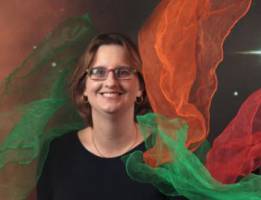
Reach for the stars - and make 'em laugh Astrophysicist, stand-up comedian, playwright's muse, Dr Kathy Romer also recently headed up the University of Sussex's Physics and Astronomy Department's Athena SWAN initiative to advance the careers of female scientists.
Event - Astronomy & Space - 24.02.2016
Astronomy & Space - Physics - 22.02.2016
Green light for gravitational wave detector in India
University scientists play crucial role in securing new gravitational wave detector for India A brand new gravitational wave detector has been approved in India after crucial support and guidance was
Astronomy & Space - Physics - 19.02.2016
Five-dimensional black hole could ’break’ general relativity
Researchers have successfully simulated how a ring-shaped black hole could cause general relativity to break down: assuming the universe contains at least five dimensions, that is.
Astronomy & Space - Physics - 15.02.2016
Exoplanet hunter: in search of new Earths and life in the Universe
Twenty years ago, in Geneva, PhD student Didier Queloz discovered a planet orbiting another sun - something that astronomers had predicted, but never found. Today he continues his terra hunting for extreme worlds and Earth twins in Cambridge. We are constantly surprised by the diversity of the other worlds.
Astronomy & Space - Physics - 11.02.2016
Saturn and Enceladus produce the same amount of plasma
The first evidence that Saturn's upper atmosphere may, when buffeted by the solar wind, emit the same total amount of mass per second into its magnetosphere as its moon, Enceladus, has been found by UCL scientists working on the Cassini mission. Magnetospheres are regions of space that are heavily influenced by the magnetic field of a nearby planet and can contain charged particles in the form of plasma from both external and internal sources.
Astronomy & Space - 11.02.2016
Sci-fi author and Imperial astrophysicist on creating new worlds
Dr Dave Clements is a Senior Lecturer in Imperial's Department of Physics and is due to launch his first collection of short science fiction stories.
Health - Astronomy & Space - 27.01.2016
Podcast: sci-fi astrophysicist, Imperial at Davos, ebola vaccine trial continues
A physicist who writes science fiction, talking up the future of materials at the World Economic Forum, and part two of a clinical trial diary.
Astronomy & Space - 13.01.2016
What does it take to be a scientific explorer in Antarctica?
Professor Martin Siegert explores some of the last unmapped areas of our planet - the land underneath the Antarctic ice sheet.
Astronomy & Space - Event - 11.01.2016
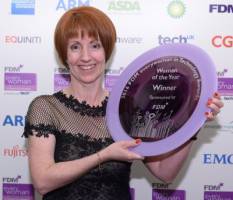
Award for “outstanding” scientist
Environment - Astronomy & Space - 06.01.2016
Teams up with National Grid on solar power project
Solar power provides up to 16 per cent of the UK's energy New project will enable more accurate measurement of Britain's solar energy supply The University of Sheffield is working with National Grid
Astronomy & Space - Physics - 18.12.2015
How real is the science in Star Wars?
The anticipation is over: The Force Awakens is with us. To a self-confessed geek like Karen Yu from the Institute for Manufacturing, this is like all of her Christmases coming at once.
Astronomy & Space - Economics - 15.12.2015
An Imperial alumnus is helping Tim Peake inspire a new generation of astronauts
As a 17-year-old sitting in the control room at NASA, alumnus Libby Jackson (BSc Physics 2002) decided that she wanted a career in the space industry.
Event - Astronomy & Space - 10.12.2015
UK’s biggest ever space celebration to take place on 15 December
Astronomy & Space - 10.12.2015
Astronauts discuss living in space ahead of Tim Peake launch
Imperial's Helen Sharman, the first Briton in space, chats to alumnus Andreas Mogensen, a recent visitor to the ISS and classmate of Tim Peake.
Physics - Astronomy & Space - 10.12.2015
Physicists awarded £8.3M to study building blocks of the Universe
University of Liverpool physicists have been awarded £8.3million by the Science and Technology Funding Council (STFC) to study the building blocks of the Universe. The funding will support key experiments being undertaken by the University's Particle Physics group in Europe, the US and Japan.
Environment - Astronomy & Space - 08.12.2015
Comment: After a 400-year population boom, we need to reconnect with the sun
Researchers from the University of Sheffield's Grantham Centre for Sustainable Futures and are sharing their expertise at the United Nations Conference on Climate Change, COP21 (30 November-11 December 2015) to help world leaders and policy makers reach a global agreement on climate change.
Astronomy & Space - Physics - 03.12.2015
University of Glasgow celebrates successful LISA Pathfinder launch
Researchers from the University of Glasgow are celebrating the successful launch of the European Space Agency's LISA Pathfinder spacecraft.
Astronomy & Space - Physics - 03.12.2015
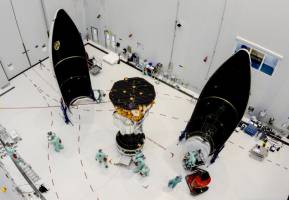
The LISA Pathfinder mission successfully launched today, on its way to demonstrate technology for observing gravitational waves from space. Gravitational waves are ripples in the fabric of spacetime, predicted a century ago by Einstein in his theory of general relativity. Einstein's theory predicts that these fluctuations are generated by massive objects that can create large distortions in spacetime, such as supernova explosions.
Life Sciences - Astronomy & Space - 01.12.2015

The catalyst that allowed the evolution of complex life in Earth's oceans has been identified by a University of Bristol researcher. Up to 800 million years ago, the Earth's oceans were deprived of oxygen. It was only when microorganisms called phytoplankton, capable of performing photosynthesis, colonised the oceans - covering two thirds of our planet - that production of oxygen at a massive scale was made possible.
Astronomy & Space - 30.11.2015
University of Glasgow project set to rocket into space
Scientists from the University of Glasgow are getting ready to see a decade's worth of painstaking work launched into space. On Wednesday December 2, the European Space Agency's LISA Pathfinder spacecraft will blast off from the Guiana Space Centre in Kourou, French Guiana atop a Vega rocket. Inside the Pathfinder is a highly sensitive 'optical bench' designed and built by a team from the University of Glasgow's Institute for Gravitational Research.
Astronomy & Space - 26.11.2015
General relativity anniversary: How do we know it’s true?
Einstein's theory of general relativity changed the way we view the universe when it was proposed 100 years ago.
Astronomy & Space - 25.11.2015
General relativity anniversary: What happens if you fall into a black hole?
Black holes are where we could experience some of the most extreme effects of general relativity. So what happens if you fall into one? This week we are celebrating the 100 th anniversary of Einstein's theory of general relativity, which he published on 25 November 1915.
Physics - Astronomy & Space - 24.11.2015
General relativity anniversary: the past, present and future of spacetime
As Imperial celebrates 100 years of general relativity, we look at the history, current research, and future direction of Einstein's famous theory. Apples fall to the Earth. Planets go around the Sun. But by the end of the 19 th century, it was clear that when examined in great detail, something was wrong with Newton's theory of gravity - it did not always work.
Environment - Astronomy & Space - 19.11.2015
Opinion: Blocking out the sun won’t fix climate change - but it could buy us time
Hugh Hunt (Department of Engineering) discusses whether we could directly engineer the climate and refreeze the poles.
Astronomy & Space - Life Sciences - 18.11.2015
Evolution website sets out to tackle great scientific unknowns
Ever wondered if a fly can ride a bicycle, or whether you could survive only on water? A new website on evolution, created by Cambridge scientists and featuring contributions from luminaries including Sir David Attenborough, has some intriguing answers.
Astronomy & Space - 16.11.2015
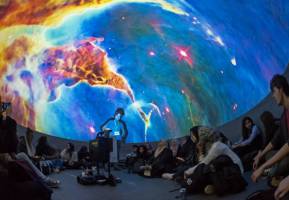
Imperial's inflatable planetarium made its debut appearance as Imperial took part in Creative Quarter 2015.
Astronomy & Space - 10.11.2015
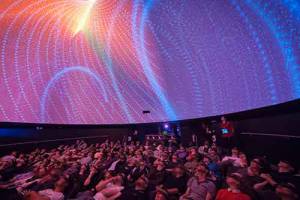
The Bristol Data Dome, housed inside At-Bristol Science Centre's Planetarium, will be launched next week [Wednesday 18 November] as part of the Festival of the Future City.
Event - Astronomy & Space - 09.11.2015
Communication award for early career researcher
Physics - Astronomy & Space - 06.11.2015
Oxford physicists share in Breakthrough Prize for seminal neutrino work
The SNO+ detector. Oxford technicians helped assemble the central 12m-diameter acrylic sphere from 225 separate tiles using the blue rigs designed and built in their workshop.
Astronomy & Space - History & Archeology - 22.10.2015
The astronomer and the witch - how Kepler saved his mother from the stake
Ulinka Rublack, Professor of Early Modern European History, discusses the reputation of astronomer Johannes Kepler and his mother Katharina, and the criminal trial for witchcraft that lasted six years.
Astronomy & Space - Physics - 12.10.2015
Birmingham to lead on autonomous vehicle project as part of £11m funding programme announced by Jaguar Land Rover and EPSRC
LISA Pathfinder (LPF), the test mission to demonstrate new technologies necessary for the planned gravitational wave observatory eLISA, will be shipped to the spaceport in Kourou on September 3rd, 2015, in preparation for launch. LISA Pathfinder paves the way for eLISA, a large space observatory for the direct observation of one of the most elusive astronomical phenomena - gravitational waves.
Physics - Astronomy & Space - 09.10.2015
Analysis: How the neutrino could solve great cosmic mysteries and win its next Nobel Prize
Analysis: How the neutrino could solve great cosmic mysteries and win its next Nobel Prize By Dr Simon Peeters , Reader (Physics and Astronomy) at the University of Sussex The humble neutrino particle won its fourth Nobel Prize in physics this year (also in , 1995 and 1988 ). Despite being millions of times smaller than other subatomic particles, it is of major importance in physics and could be the key to unravelling some of the universe's best-kept secrets.
Astronomy & Space - 07.10.2015

Jodrell Bank Discovery Centre will be part of the exciting new Destination Space programme.
Physics - Astronomy & Space - 06.10.2015
Neutrinos scoop the Nobel Prize in Physics 2015
The prize has been awarded to two physicists who discovered a strange property of neutrinos, which Imperial scientists are still unravelling today.
Chemistry - Astronomy & Space - 05.10.2015
Former astronaut Helen Sharman finds a new space at Imperial
In 1991, chemist Helen Sharman blasted off for a seven-day mission to the Mir space station, becoming the first Briton in space.
Astronomy & Space - Life Sciences - 05.10.2015
The Liverpool View: Searching for extraterrestrial life
Dr Joao Pedro De Magalhaes is a Senior Lecturer in Functional and Comparative Genomics in the University of Liverpool's Institute of Integrative Biology.
Astronomy & Space - Physics - 02.10.2015
Hunt for Einstein’s "elusive" gravitational waves begins
University researchers begin their search for tiny ripples in space University researchers have begun looking for the first direct evidence of the existence of gravitational waves. Two upgraded detectors, based at Hanford and Livingston in the US, have been brought online and are starting to search for signals with unprecedented accuracy as part of the Advanced LIGO (Laser Interferometer Gravitational Wave Observatory) Project.
Astronomy & Space - Administration - 30.09.2015
Observing the Universe from the classroom
New funding for University outreach project gives thousands of Welsh schoolchildren access to global high-tech telescope network Primary school children in Wales will be given the chance to explore t
Astronomy & Space - 25.09.2015
EXPERT COMMENT: Supermoon eclipse
Physics - Astronomy & Space - 23.09.2015
Astronomy & Space - Physics - 22.09.2015
Oxford to Build Spectrograph for World’s Largest Optical Telescope
HARMONI will provide the world's largest visible and infrared telescope with unprecedented physical insights about objects in the distant Universe. University of Oxford researchers will lead the design and build of the HARMONI spectrograph for the European Extremely Large Telescope (E-ELT), as part of a contract signed today by the European Southern Observatory.
Astronomy & Space - Physics - 16.09.2015
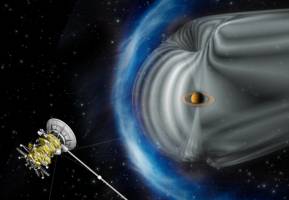
The Cassini space probe has detected unusually strong shock waves near Saturn, similar to those driven by supernovae. Data from the probe as it encountered these very strong shock waves is helping Imperial College London scientists to understand exploding stars (known as supernovae) and the nature of plasma - the fourth state of matter that occupies 99 per cent of the visible universe.
Astronomy & Space - Physics - 16.09.2015
Analysis: How Hubble’s successor will give us a glimpse into the very first galaxies
Analysis: How Hubble's successor will give us a glimpse into the very first galaxies By Dr Stephen Wilkins , Lecturer in Physics Astronomy at the University of Sussex A key feature of our understanding of cosmology is that the universe has a finite age.
Astronomy & Space - Physics - 14.09.2015
Astronomers peer into the ’amniotic sac’ of a planet-hosting star
Astronomers have successfully peered through the 'amniotic sac' of a star that is still forming to observe the innermost region of a burgeoning solar system for the first time. In a research paper published today in the journal Monthly Notices of the Royal Astronomical Society , an international team of astronomers describe surprising findings in their observations of the parent star, which is called HD 100546.
Astronomy & Space - Physics - 03.09.2015
Detecting gravitational waves in space: LISA Pathfinder test mission launch imminent
LISA Pathfinder (LPF), the test mission to demonstrate new technologies necessary for the planned gravitational wave observatory eLISA, will be shipped to the spaceport in Kourou on September 3rd, 2015, in preparation for launch. LISA Pathfinder paves the way for eLISA, a large space observatory for the direct observation of one of the most elusive astronomical phenomena - gravitational waves.
Astronomy & Space - Physics - 31.08.2015
University of Glasgow space tech ready for liftoff
A new piece of technology which will help in the search for gravitational waves is setting off for South America on its final earthbound journey before heading to space.
Astronomy & Space - Electroengineering - 21.08.2015
ESA astronaut and Imperial alumnus prepares for space mission
Dr Andreas Mogensen launches next month on board a 10-day mission to restock the International Space Station and carry out zero-g science experiments.
Astronomy & Space - Earth Sciences - 20.08.2015
Rosetta mission uncovered at Museum
Senior Science Adviser at European Space Agency discusses 'most exciting space exploration mission in decades' Almost a year since the Rosetta spacecraft rendezvoused with a comet over 400 million km


