Published today in Royal Society Interface, the study is the result of more than five years of research by the team at the RVC, including Dr James Charles (now at the University of Liverpool); Dr Delyle Polet; and Professor John Hutchinson, Professor of Evolutionary Biomechanics. Together, the researchers used advanced biomechanical simulations to investigate how tail movement influenced jumping performance in early dinosaurs compared with a living bird.
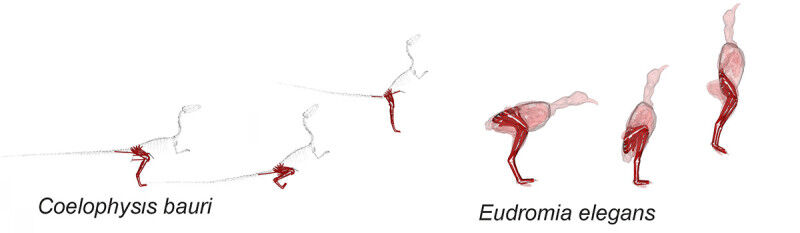
This included building a 3D digital model of Coelophysis bauri, an early, long-tailed theropod (carnivorous) dinosaur that lived around 210 million years ago and weighed approximately 13kg. The research team then ran sophisticated computer simulations - borrowing modelling techniques developed in medicine and aeronautics - to recreate how the dinosaur jumped. Creating a simulation in unprecedented detail, the researchers then tested the accuracy of this model by comparing it to an animal with similar proportions without a tail - a South American tinamou bird.
The simulations revealed that in the Coelophysis, greater mobility of the tail joints led to higher jumps. This finding aligns with fossil evidence which shows that Coelophysis’ tail vertebrae were well suited to pitching the tail up and down. In contrast, other factors, such as tail mass, muscle strength or whether the tail could touch the ground had much smaller effects on jumping performance.
The simulations also demonstrated that despite their different anatomies, the dinosaur and bird achieved similar jumping heights relative to their body sizes - approximately one metre for Coelophysis and 30cm for the tinamou bird. This similarity arises because both animals have comparable limb proportions and muscular investment. However, they reached these heights using markedly different techniques - the tinamou jumped by pitching its body sharply upwards, relying heavily on its hip muscles, while Coelophysis swung its tail and used more evenly distributed forces across the hip, knee and ankle muscles.
Dr James Charles, former postdoctoral researcher at the RVC, and lead author of the paper, said:
"While fundamental biomechanical principles suggested both animals would reach similar heights, the vastly different techniques they used were a fascinating revelation. It allowed us to tease apart how form relates to function; where the bird relies on its hips, Coelophysis recruited its entire leg and a highly mobile tail to get airborne. It’s clear there is no ’single way’ for a theropod to jump, and these findings open new doors into how agility evolved across millions of years."
Dr Delyle Polet, postdoctoral researcher at the Evolutionary Biomechanics Lab at Imperial College London, and co-lead author of the paper, said:
"Exploring the potential abilities of animals that no longer exist today reveals surprising mechanisms of locomotion. This not only raises questions for living animals - such as whether leaping lizards use their tails in similar ways - but also could inspire robotic designs that aren’t limited by evolutionary history."
Dr John Hutchinson, Professor of Evolutionary Biomechanics at the RVC, and co-author of the study, said:
"Science has not yet been able to infer the jumping abilities of many extinct organisms at all. Yet the biomechanics of vertical jumping are reasonably well understood. Our study opens new vistas for how science can use predictive simulations like ours not only to estimate how well different species might have jumped, but also how jumping evolved. Jumping is important to the ecology of many species, so these would be exciting insights."
Reference
Charles, J.P.; Polet, D.T., Hutchinson, J.R. 2026. Form-function relationships determining optimal jumping performance in an early bipedal dinosaur. Journal of the Royal Society Interface 22:20250918.The full paper can be accessed at: https://doi.org/10.1098/rsif.2025.0918
About the RVC
- The Royal Veterinary College (RVC) is the UK’s largest and longest established independent veterinary school and is a Member Institution of the University of London.
- It is one of the few veterinary schools in the world that hold accreditations from the RCVS in the UK (with associated recognition from the AVBC for Australasia, the VCI for Ireland and the SAVC for South Africa), the EAEVE in the EU, and AVMA in the USA and Canada.
- The RVC is ranked as the top veterinary school in the world in the QS World University Rankings by subject, 2025.
- The RVC offers undergraduate and postgraduate programmes in veterinary medicine, veterinary nursing and biological sciences.
- The RVC is a research-led institution, with 88% of its research rated as internationally excellent or world class in the Research Excellence Framework 2021.
- The RVC provides animal owners and the veterinary profession with access to expert veterinary care and advice through its teaching hospitals and first opinion practices in London and Hertfordshire.
A new study led by the Royal Veterinary College (RVC) and Imperial College London has revealed how ...