Credit: Thomas Angus
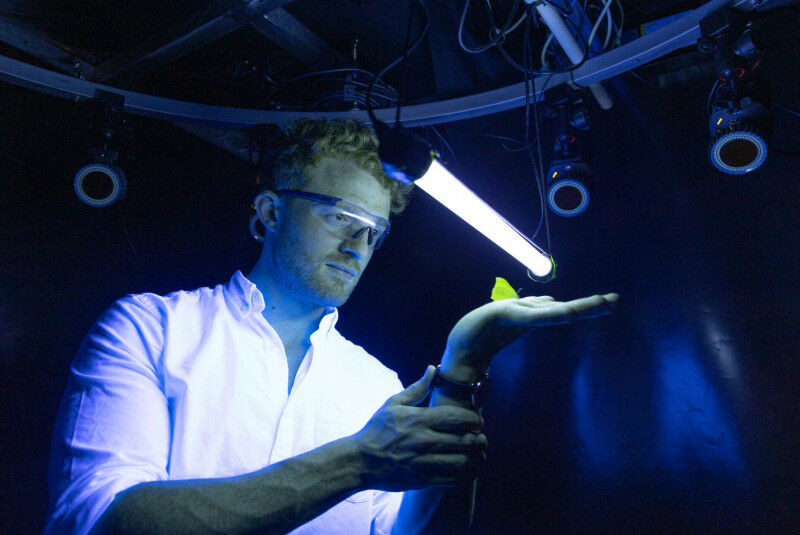
Credit: Thomas Angus - Slow-motion videos collected and analysed by Imperial College London researchers give us new insights into why nocturnal insects gather around light. A Bug's Life fans might remember the unfortunate trance-like state of a mosquito, who, despite calls to 'not look into the light' just couldn't help it, because 'it is so beautiful.' In fact, phototaxis - the movement of organisms in response to light - has interested researchers for years, and yet the reasons behind nocturnal insects' transfixion with light is highly debated. Popular theories have proposed that insects mistake the light for a gap in foliage and incorrectly use it to escape, or that the light is used as a navigational tool. Researchers have also suggested insects are attracted to the heat of the light, or that they become blinded by the light, causing erratic movements and crashes. Now, researchers from the Department of Bioengineering at Imperial have found that flying insects are not attracted to light, but become disorientated by it as they think it is the sky, and therefore the way 'up' - which causes them to crash. The lead author of the study Dr Samuel Fabian, from the Department of Bioengineering at Imperial, said: "We wanted to understand why insects seem unable to resist flying into and around potentially fatal light sources. Answering this question could help us get a better grip on humans' impact on insects and the wider natural world." They used stereo-videography in Costa Rica, and high-resolution motion capture and computer analyses in the lab to reconstruct the 3D movements of insect flights around artificial light.
TO READ THIS ARTICLE, CREATE YOUR ACCOUNT
And extend your reading, free of charge and with no commitment.