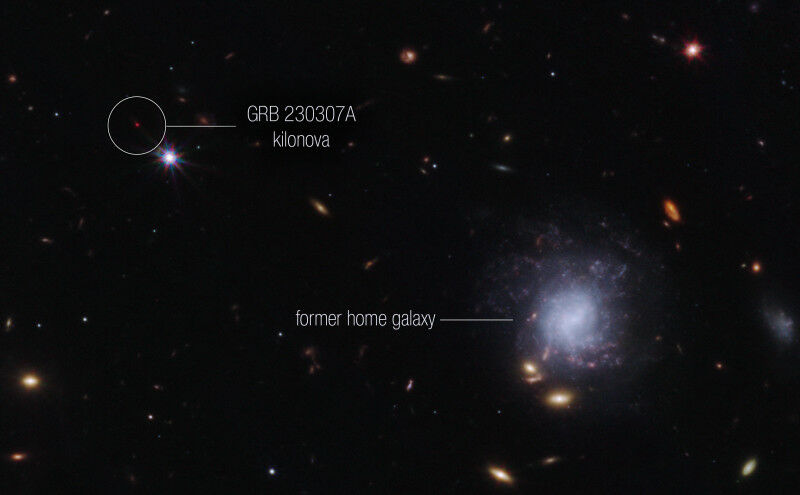
The stars travelled the approximate length of the Milky Way (about 120,000 light-years) outside of their home galaxy, before merging. Credit: NASA, ESA, CSA, STScI, Andrew Levan (IMAPP, Warw).
The stars travelled the approximate length of the Milky Way (about 120,000 light-years) outside of their home galaxy, before merging. Credit: NASA, ESA, CSA, STScI, Andrew Levan (IMAPP, Warw). Scientists have observed the creation of rare chemical elements in the second-brightest gamma-ray burst ever seen. Scientists have observed the creation of rare chemical elements in the second-brightest gamma-ray burst ever seen - casting new light on how heavy elements are made. Researchers examined the exceptionally bright gamma-ray burst GRB 230307A, which was caused by a neutron star merger. The explosion was observed using an array of ground and space-based telescopes, including NASA's James Webb Space Telescope, Fermi Gamma-ray Space Telescope, and Neil Gehrels Swift Observatory. Publishing their findings today in Nature (25 Oct), the international research team which included experts from the University of Birmingham, reveal that they found the heavy chemical element tellurium, in the aftermath of the explosion.
TO READ THIS ARTICLE, CREATE YOUR ACCOUNT
And extend your reading, free of charge and with no commitment.