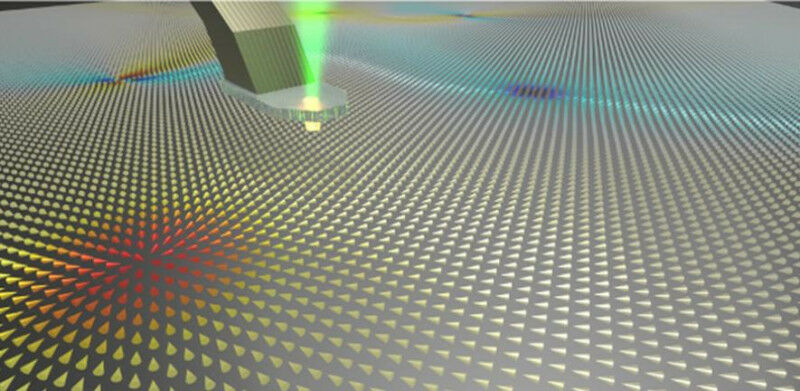
Magnetic monopoles in hematite Credit: Anthony Tan and Michael Hoegen
Magnetic monopoles in hematite Credit: Anthony Tan and Michael Hoegen Researchers have discovered magnetic monopoles - isolated magnetic charges - in a material closely related to rust, a result that could be used to power greener and faster computing technologies. If monopoles did exist, and we were able to isolate them, it would be like finding a missing puzzle piece that was assumed to be lost Mete Atatüre Researchers led by the University of Cambridge used a technique known as diamond quantum sensing to observe swirling textures and faint magnetic signals on the surface of hematite, a type of iron oxide. The researchers observed that magnetic monopoles in hematite emerge through the collective behaviour of many spins (the angular momentum of a particle). These monopoles glide across the swirling textures on the surface of the hematite, like tiny hockey pucks of magnetic charge. This is the first time that naturally occurring emergent monopoles have been observed experimentally. The research has also shown the direct connection between the previously hidden swirling textures and the magnetic charges of materials like hematite, as if there is a secret code linking them together. The results , which could be useful in enabling next-generation logic and memory applications, are reported in the journal Nature Materials .
TO READ THIS ARTICLE, CREATE YOUR ACCOUNT
And extend your reading, free of charge and with no commitment.