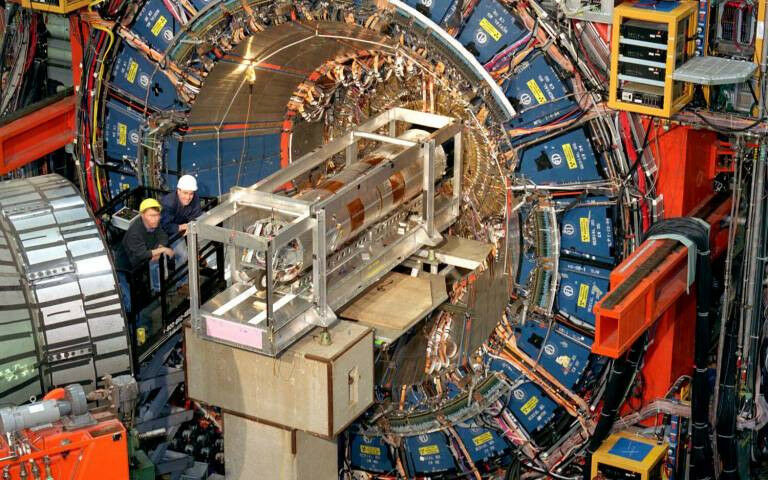
The Collider Detector at Fermilab
The Collider Detector at Fermilab - An international team including researchers at UCL have made the most precise measurement of an elementary particle - which does not match predictions under the guiding theory of physics. The Collider Detector at Fermilab (CDF) collaboration, which involves 400 scientists from around the world, have measured the mass of the W boson, one of nature's force-carrying particles. The measurement does not match the value expected based on the Standard Model of particle physics, suggesting there may need to be new, as yet undiscovered, pieces added to the long-standing theory. Professor David Waters (UCL Physics & Astronomy), UCL High Energy Physics Group Leader and CDF Collaboration Member, said: "This new result from the CDF experiment, in which UCL was closely involved over many years, is potentially very exciting. The W boson is responsible for the weak nuclear force that mediates radioactive beta-decay and some of the nuclear processes taking place inside the Sun. "By measuring very precisely how much the W boson weighs, we are testing Standard Model calculations that take into account quantum fluctuations involving heavy particles. "This latest measurement is different to what is predicted, and adds to recent evidence from other experiments, such as those at Fermilab and CERN, that the Standard Model of particle physics may be missing some key elements - perhaps new particles or forces.
TO READ THIS ARTICLE, CREATE YOUR ACCOUNT
And extend your reading, free of charge and with no commitment.