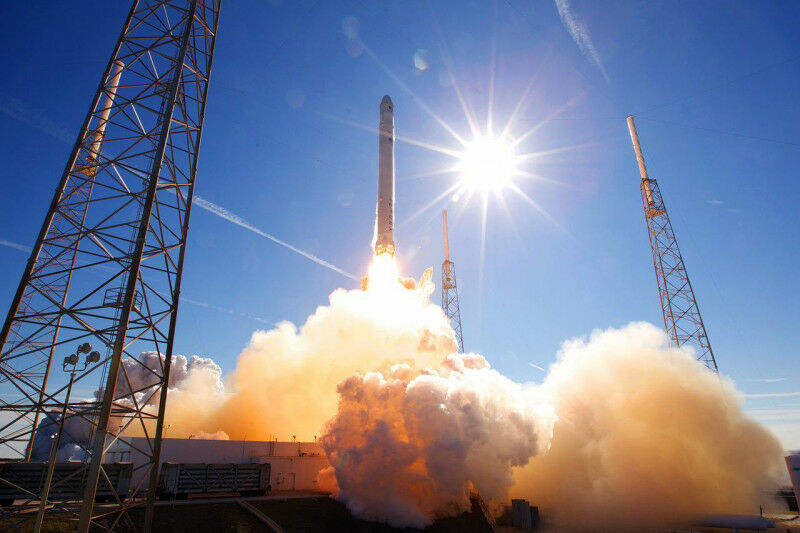
Rocket Launch Spacex Lift-Off (Image: pixabay)
Rocket Launch Spacex Lift-Off (Image: pixabay) A formidable space tourism industry may have a greater climate effect than the aviation industry and undo repair to the protective ozone layer if left unregulated, according to a new study led by UCL. Published today in the journal Earth's Future , researchers from UCL, the University of Cambridge and Massachusetts Institute of Technology (MIT) used a 3D model to explore the impact of rocket launches and re-entry in 2019, and the impact of projected space tourism scenarios based on the recent billionaire space race. The team found that black carbon (soot) particles emitted by rockets are almost 500 times more efficient at holding heat in the atmosphere than all other sources of soot combined (surface and aircraft) - resulting in an enhanced climate effect. Furthermore, while the study revealed that the current loss of total ozone due to rockets is small, current growth trends around space tourism indicate potential for future depletion of the upper stratospheric ozone layer in the Arctic in spring. This is because pollutants from solid-fuel rockets and re-entry heating of returning spacecraft and debris are particularly harmful to stratospheric ozone. Study co-author Dr Eloise Marais (UCL Geography) said: "Rocket launches are routinely compared to greenhouse gas and air pollutant emissions from the aircraft industry, which we demonstrate in our work is erroneous. "Soot particles from rocket launches have a much larger climate effect than aircraft and other Earth-bound sources, so there doesn't need to be as many rocket launches as international flights to have a similar impact.
TO READ THIS ARTICLE, CREATE YOUR ACCOUNT
And extend your reading, free of charge and with no commitment.