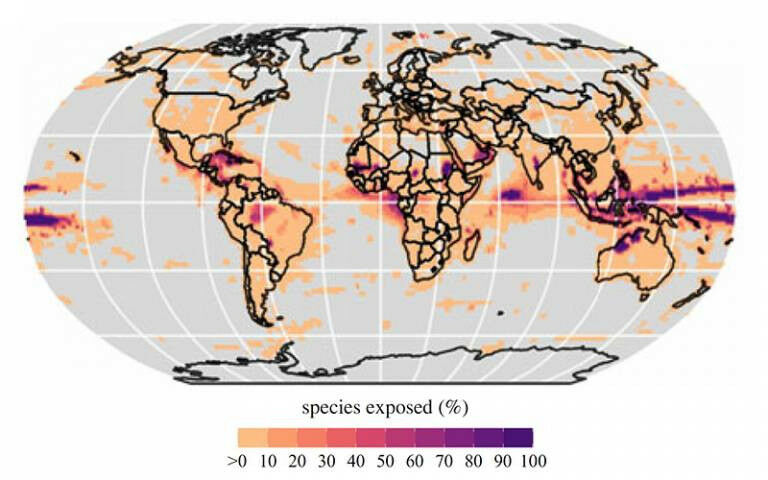
Map showing where animals are vulnerable to climate change - Map displaying the maximum percentage pf species exposed to unsafe temperatures between 2015 and 2300, showing how in many tropical regions, the majority of species will be at risk.
Map showing where animals are vulnerable to climate change - Map displaying the maximum percentage pf species exposed to unsafe temperatures between 2015 and 2300, showing how in many tropical regions, the majority of species will be at risk. Even if global temperatures begin to decline after peaking this century because of climate change, the risks to biodiversity could persist for decades after, finds a new study by UCL and University of Cape Town researchers. The paper, published in Philosophical Transactions of the Royal Society B: Biological Sciences , models the potential impacts on global biodiversity if temperatures increase by more than 2°C compared to pre-industrial levels, before beginning to decline again. The Paris Agreement, signed in 2015, aims to limit global warming to well below 2°C, preferably to 1.5°C. However, as global greenhouse gas emissions continue to increase, many scenarios now feature a multiple decades-long 'overshoot' of the Paris Agreement limit, then factor in the effects of potential carbon dioxide removal technology to reverse dangerous temperature rise by 2100. Climate change and other human influences are already causing an ongoing biodiversity crisis, with mass die-offs in forests and coral reefs, altered species distributions and reproductive events, and many other ill effects. Co-author Dr Alex Pigot (UCL Centre for Biodiversity & Environment Research, UCL Biosciences) said: "We have investigated what will happen to global biodiversity if climate change is only brought under control after a temporary overshoot of the agreed target, to provide evidence that has long been missing from climate change research.
TO READ THIS ARTICLE, CREATE YOUR ACCOUNT
And extend your reading, free of charge and with no commitment.