Supercomputer simulations unlock space weather puzzle
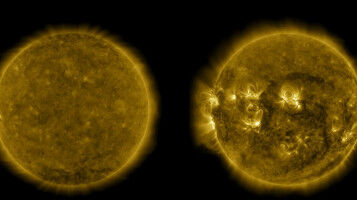
Scientists have long questioned why the bursts of hot gas from the Sun do not cool down as fast as expected, and now a UCL-led team of researchers have used a supercomputer to find out why. The team will now compare their simulations with 'real' data from the European Space Agency's flagship Solar Orbiter mission, with the hope that it will confirm their predictions and provide a conclusive answer. The solar wind is a stream of charged particles continuously shot out from the Sun into the solar system. These ejections greatly impact the conditions of our solar system and constantly hit the Earth. When the solar wind hits the Earth, it is almost 10 times hotter than expected, with a temperature of about 100,000 to 200,000 degrees Celsius. The outer atmosphere of the Sun, where the solar wind originates, is typically a million degrees C. If the solar wind is particularly strong, it can cause problems to satellites, astronauts in space, mobile phones, transport and even electricity networks that power our homes. To successfully forecast and prepare for such space weather events, a team of scientists are trying to solve the mysteries that space weather holds, including how the solar wind is heated and accelerated.