Particle’s ’wobble’ hints at new physics
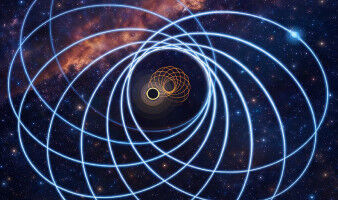
The "wobble", or rate of precession, of the muon particle in a magnetic field is different from what our best theoretical model of the subatomic world would predict, according to an experiment involving UCL researchers that strengthens evidence for new, unknown physics. The Muon g-2 experiment, carried out at the Fermi National Accelerator Laboratory in the United States, measured with unprecedented precision the rate at which the muon "wobbled" (precessed) as it circulated a 15-metre magnetic ring at nearly the speed of light. When placed in a magnetic field, the particle acts like a tiny magnetic compass and, like the axis of a spinning top, it precesses, or rotates, as its spins. This rotation was faster than is predicted by the Standard Model of particle physics. Dr Gavin Hesketh (UCL Physics & Astronomy), g-2 lead at UCL, said: "The new result gives strong evidence that there may be a previously unknown particle or force of nature influencing the muon's behaviour. This measurement could mark the start of a new leap in our understanding of the universe." Dr Rebecca Chislett (UCL Physics & Astronomy), who led building and running the data acquisition system for the experiment, said: "The Standard Model is very successful at accurately describing the very smallest things in the universe that we know about. But it doesn't explain everything - such as gravity, or dark matter.