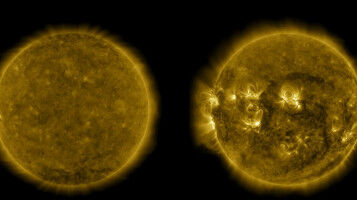
Solar eruptions, including enormous coronal mass ejections (pictured), could be triggered by a single process. Credit: NASA/SDO
Solar eruptions, including enormous coronal mass ejections (pictured), could be triggered by a single process. Credit: NASA/SDO Large and small scale solar eruptions might all be triggered by a single process, according to new research that leads to better understanding of the Sun's activity. Researchers at Durham University and NASA's Goddard Space Flight Center, USA, used 3D computer simulations to show a theoretical link between large and small scale eruptions that were previously thought to be driven by different processes. They looked at the mechanism behind coronal jets - relatively small bursts of plasma (hot gas) from the Sun - and much larger-scale coronal mass ejections (CMEs), where giant clouds of plasma and magnetic field are blown into space at high speed. Snake-like filaments Both types of eruptions were known to involve snake-like filaments of dense plasma low in the Sun's atmosphere, but until now how they erupted at such vastly different scales was unclear. The researchers discovered that the filaments in jets are triggered to erupt when the magnetic field lines above them break and rejoin - a process known as magnetic reconnection. The same process was previously known to explain many CMEs.
TO READ THIS ARTICLE, CREATE YOUR ACCOUNT
And extend your reading, free of charge and with no commitment.