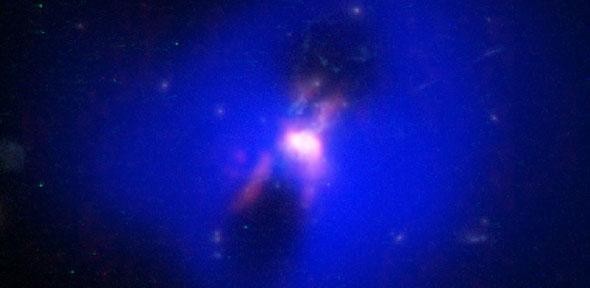
Credit: ALMA
Astronomers using the Atacama Large Millimeter/submillimeter Array (ALMA) have discovered a surprising connection between a supermassive black hole and the galaxy where it resides. This gives us new insights into how a black hole can regulate future star birth - Helen Russell Powerful radio jets from the black hole - which normally suppress star formation - are stimulating the production of cold gas in the galaxy's extended halo of hot gas. This newly identified supply of cold, dense gas could eventually fuel future star birth as well as feed the black hole itself. The researchers used ALMA to study a galaxy at the heart of the Phoenix Cluster, an uncommonly crowded collection of galaxies about 5.7 billion light-years from Earth. The central galaxy in this cluster harbours a super-massive black hole that is in the process of devouring star-forming gas, which fuels a pair of powerful jets that erupt from the black hole in opposite directions into intergalactic space. Astronomers refer to this type of black-hole powered system as an active galactic nucleus (AGN). Earlier research with NASA's Chandra X-ray observatory revealed that the jets from this AGN are carving out a pair of giant 'radio bubbles', huge cavities in the hot, diffuse plasma that surrounds the galaxy. Previously, astronomers believed that this region would be too hot for the gas to cool and condense, preventing it from fuelling future star birth or feeding the super-massive black hole.
TO READ THIS ARTICLE, CREATE YOUR ACCOUNT
And extend your reading, free of charge and with no commitment.