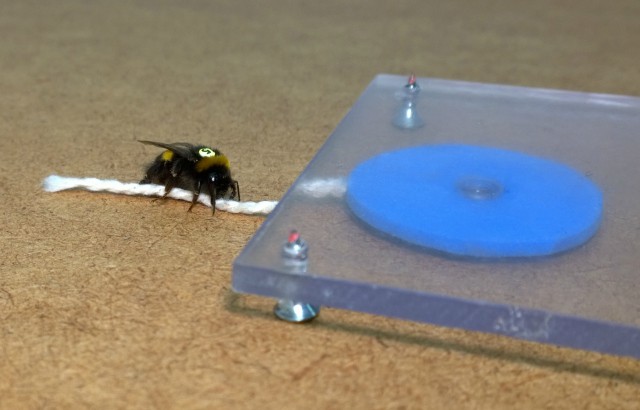
A bumblebee pulling a string. Credit: Olli Loukola
Bumblebees can learn to pull strings for food and pass on the ability to a colony, according to researchers at Queen Mary University of London (QMUL). Pulling strings to obtain food is an experiment often used to test the intelligence of apes and birds, but it is the first time this technique has been discovered in an insect. Moreover the cultural spread of such a technique from a single informed individual has also been described for the first time in an invertebrate animal. The results, published in PLOS Biology , show that rare innovator bees were able to solve the problem of pulling the string to reach a sugar water reward by themselves while most others could learn to pull the string when trained. Naïve bees were then able to learn the task by observing a trained demonstrator bee while this skill was passed down through several generations of learners, ensuring its longevity in the population. Dr Sylvain Alem, lead author of the study, said: 'We found that when the appropriate social and ecological conditions are present, culture can be mediated by the use of a combination of simple forms of learning. Thus, cultural transmission does not require the high cognitive sophistication specific to humans, nor is it a distinctive feature of humans.' Dr Clint Perry, another lead author of the study, added: 'Despite the obvious differences between humans and other animals, understanding social learning and culture in animals holds a key to understanding the evolutionary roots of the peculiarities of social learning and culture in humans.' To test the bees?
TO READ THIS ARTICLE, CREATE YOUR ACCOUNT
And extend your reading, free of charge and with no commitment.