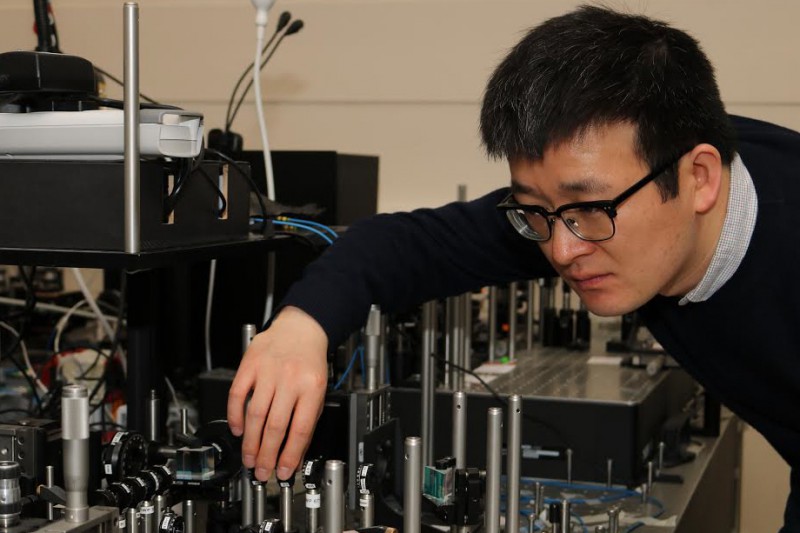
 Bristol PhD student Xiaogang Qiang and the primitive photonic quantum processor he designed with UWA researchers to simulate quantum walks
Gerardo Villarreal Garcia.
Bristol PhD student Xiaogang Qiang and the primitive photonic quantum processor he designed with UWA researchers to simulate quantum walks
Gerardo Villarreal Garcia.
Scientists and engineers from the Universities of Bristol and Western Australia have developed how to efficiently simulate a "quantum walk" on a new design for a primitive quantum computer. Quantum computers have significant potential to open entirely new directions for processing information and to overhaul the way that we think about and use the science of computation. Modern computers already play a huge role in society — they routinely handle and process vast amounts of data and solve calculations at an incredible rate. However, there are some problems that they just cannot solve in a useful amount of time, no matter how fast they become. The concept of a quantum computer aims to address this, exploring uncharted computation and solving at least some of these problems that classical computers cannot. The study , reports strong evidence that with this method something meaningful can already be seen with a primitive quantum computer that cannot be seen with a classical computer. The very first steps towards this have been implemented in the lab in Bristol.
TO READ THIS ARTICLE, CREATE YOUR ACCOUNT
And extend your reading, free of charge and with no commitment.
Your Benefits
- Access to all content
- Receive newsmails for news and jobs
- Post ads