Rami Alfarra
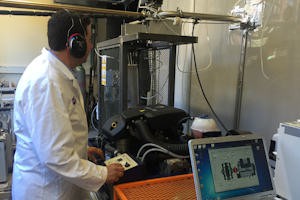
A team at The University of Manchester is testing a Volkswagen diesel engine to try to get an accurate picture of how polluting it is. Even before the recent scandal erupted over software that fakes tests, research results from Manchester were starting to show the true picture of just how dirty diesel engines can be. The team have attached the engine to a specially made atmospheric chamber, which can accurately monitor exactly what emissions are coming from it and, crucially, how these particles react with sunlight to create unhealthy dirty air, known as secondary pollution. They have presented their preliminary findings at conferences in Milan earlier this month, and in the USA last year. The key findings are: High levels of Nitrogen Oxides and particulates emitted at elevated levels under conditions not represented in the current testing protocols These emissions react strongly with sunlight to create secondary pollutants such as ozone and particulate matter, which are known to be hazardous Watch a video about the work The team also found that the engine was much more polluting when it is first turned on and then when rapidly accelerating, two elements that are not used when engines are being tested for emissions. It all adds up to further evidence that a new testing regime reflecting real-world driving conditions is required. Research fellow Dr. Rami Alfarra, a member of the National Centre for Atmospheric Science, is managing the work, which has been funded by the Natural Environment Research Council (NERC) and is a collaboration with Birmingham and York Universities.
TO READ THIS ARTICLE, CREATE YOUR ACCOUNT
And extend your reading, free of charge and with no commitment.