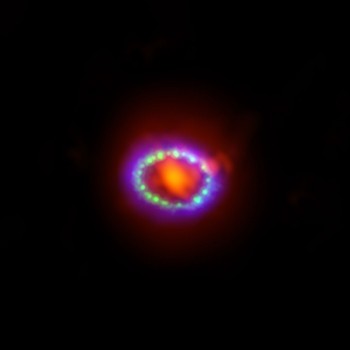
the remnant of Supernova 1987A seen in light of very different
wavelengths. ALMA data (in red) shows newly formed dust in the centre of
the remnant. Hubble (in green) and Chandra (in blue) data show the
expanding shock wave.
UK scientists have used the ALMA telescope to help capture the remains of a recent supernova - or exploding star - that is brimming with freshly formed dust 160,000 light years from Earth. Supernovae are thought to produce a large amount of the dust within galaxies, especially in the early Universe, but direct evidence of their ability to create dust has been limited - until now. The results appear in Astrophysical Journal Letters . An international team of scientists including those from UCL Mullard Space Science Laboratory and Keele University have used the European Southern Observatory (ESO)'s Atacama Large Millimeter/submillimeter Array (ALMA) telescope to observe the glowing remains of Supernova 1987A. The relatively young supernova is in the Large Magellanic Cloud, a dwarf galaxy orbiting the Milky Way about 160,000 light-years from Earth. SN 1987A is the closest observed supernova explosion since Johannes Kepler's observation of a supernova inside the Milky Way in 1604. "Really early galaxies are incredibly dusty and this dust plays a major role in the evolution of galaxies," said Mikako Matsuura (UCL Mullard Space Science Laboratory). "Today we know dust can be created in several ways, but in the early Universe most of it must have come from supernovae.
TO READ THIS ARTICLE, CREATE YOUR ACCOUNT
And extend your reading, free of charge and with no commitment.