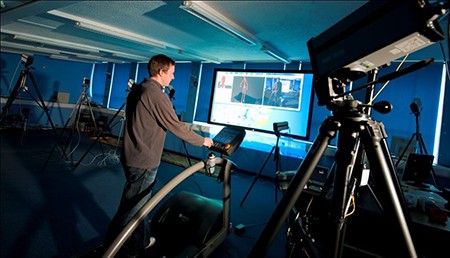
The study analysed 25,000 human steps made on a pressure-sensitive treadmill at the University’s Gait Laboratory
Research at the University of Liverpool has shown that the mechanisms of the human foot are not as unique as originally thought and have much more in common with the flexible feet of other great apes. Current understanding of the evolution of human walking is based on research from the 1930s, which proposes that human feet function very differently to those of other apes, due to the development of arches in the mid-foot region and the supposed rigidity of that on the outside edge of the foot. Surprising amount of flexibility In a study of more than 25,000 human steps made on a pressure-sensitive treadmill at the University's Gait Laboratory, scientists at Liverpool have shown that despite having abandoned life in the trees long ago, our feet have retained a surprising amount of flexibility, the type seen in the feet of other great apes, such as orang-utans and chimpanzees, that have remained largely tree-dwelling. "We found that the range of pressures exerted under the human mid-foot, and thus the internal mechanisms that drive them, were highly variable, so much so that they actually overlapped with those made by the great apes” - Professor Robin Crompton, from the University's Institute of Ageing and Chronic Disease , explains: " - "This supposed 'uniqueness', however, has never been quantitatively tested.
TO READ THIS ARTICLE, CREATE YOUR ACCOUNT
And extend your reading, free of charge and with no commitment.