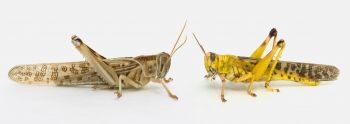
A solitary male desert locust (left) facing a gregarious male (right) of the same species. Image: Tom Fayle, University of Cambridge
Locust research shows how the company you keep shapes what you learn. A team of scientists has shown how the environment shapes learning and memory by training locusts like Pavlov's dog to associate different smells with reward or punishment. Desert locusts are notorious for their devastating swarms. However, they do not always live in swarms — they switch between a lone living 'solitary phase' and a swarming 'gregarious' phase. The two phases differ profoundly in looks, behaviour and in their life style. The new research from the Universities of Sussex, Leicester and Cambridge, published today (21 November 2013) in the journal Current Biology , examines how locusts associate odours with nutritious or toxic food. Solitary locusts rely on camouflage to evade predators, and they avoid eating toxic plants; but gregarious locusts eat these plants to 'impregnate' themselves with toxins to deter predators.
TO READ THIS ARTICLE, CREATE YOUR ACCOUNT
And extend your reading, free of charge and with no commitment.