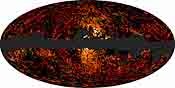
The "Galactic Haze" as measured by Planck, seen as a glow near the Galactic Centre. The dark band across the middle is where strong emission from the rest of the Galaxy has been blanked out. The origin of the Haze is not yet known, though there are a number of possibilities. Image credit: ESA/Planck collaboration.
The European Space Agency's Planck mission with the support of University astronomers has unveiled more surprises about our Galaxy, bringing scientists closer to being able to understand the structure of the Universe. The results include previously unknown clouds of cold gas, and a mysterious haze of microwave emission near the centre of the Galaxy. Planck is surveying the sky at microwave wavelengths, with a primary science goal of observing the Cosmic Microwave Background - the afterglow of the Big Bang. But in the course of its cosmological quest Planck is also making maps of anything in the foreground, which includes our own Galaxy. Astronomers from around the world including those from the University's School of Physics and Astronomy are busily pouring over these maps, with some of the intermediate results being presented for the first time. Most of the emission from our Galaxy is due to hot gas and dust between the stars, or from very energetic electrons moving through magnetic fields. Planck's instruments are also able to pick up the emission from very cold clouds of gas scattered throughout the Milky Way.
TO READ THIS ARTICLE, CREATE YOUR ACCOUNT
And extend your reading, free of charge and with no commitment.