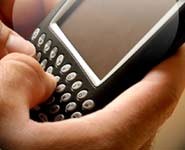
Antenna position and user grip on smartphones may lead to obstruction of radio signal paths and antenna detuning.
Press release issued 28 February 2011 - The growth in the demand of smartphones has highlighted the complexities of wireless communications through problems of reduced sensitivity when the user holds some devices. New research has been investigating this problem, along with developing new solutions to overcome the loss of connectivity. The study by academics in the field of antennas and propagation in the University of Bristol's Centre for Communications Research (CCR) is published in the journal IEEE Antennas and Wireless Propagation Letters . The paper builds on previous work that analysed multi-antenna or multiple-input multiple-output (MIMO) enabled wireless devices, such as those now synonymous with the latest cellular radio and wireless local area network (LAN) products. The new research rigorously characterised the effects of the antenna being obstructed by the user's hand on the device, when it was in contact with a 'thumb phantom' with the dielectric properties of skin and also when operating hands-free. The researchers showed how signal levels change due to obstruction, position and motion, and that signal fluctuations increase significantly, therefore tending to impair service quality. The academics also examined how proximity of the operator's hand affects the antenna's radiation and input characteristics.
TO READ THIS ARTICLE, CREATE YOUR ACCOUNT
And extend your reading, free of charge and with no commitment.