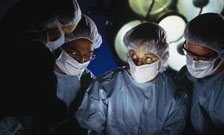
An operating theatre
A study co-led by researchers at King's College London shows that the percentage of men who had a radical prostatectomy (removal of the prostate and surrounding cancer cells) and survived for 15 years is higher than men who were only given treatment at signs of further progression of prostate cancer, an approach known as 'watchful waiting.' Scientists say that this represents clear evidence that operations remain a very effective treatment for prostate cancer. The next question to answer is whether operations are more effective than 'active surveillance' - an approach now commonly used to monitor the disease very carefully and deliver curative treatment at the first sign of progression. This is a more active approach than watchful waiting. This study, published in the New England Journal of Medicine , is a 15 year follow-up to a study which looked at 695 men diagnosed with early prostate cancer between 1989 and 1999. Half of the participants were assigned to radical prostatectomy and the other group treated with a watchful waiting approach. Study findings Findings show that over the last 15 years 55 of the 347 men assigned to surgery (14.6 percent) and 80 of the 348 men assigned to watchful waiting (20.7 percent) died as a result of prostate cancer.
TO READ THIS ARTICLE, CREATE YOUR ACCOUNT
And extend your reading, free of charge and with no commitment.