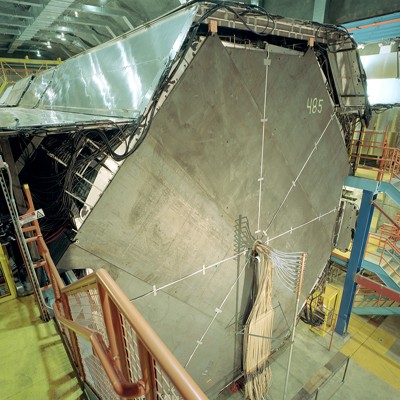
The MINOS far detector is located in a cavern half a mile underground in
the Soudan Underground Laboratory, Minnesota. The 100-foot-long MINOS
far detector consists of 486 massive octagonal planes, lined up like the
slices of a loaf of bread. Each plane consists of a sheet of steel
about 25 feet high and one inch thick, with the last one visible in the
photo. The whole detector weighs 6,000 tons. Since March 2005, the far
detector has recorded neutrinos from a beam produced at Fermilab. The
MINOS collaboration records about 1,000 neutrinos per year. The MINOS
collaboration records about 1,000 neutrinos per year. A tiny fraction of
them seem to be electron neutrinos. Credit: Fermilab
Scientists involved in the MINOS experiment, including six members from UCL Physics and Astronmy, have announced the results from a search for a rare phenomenon: the transformation of muon neutrinos into electron neutrinos. The results of these two experiments could have implications for our understanding of the role that neutrinos may have played in the evolution of the universe. If muon neutrinos transform into electron neutrinos, neutrinos could be the reason that the big bang produced more matter than antimatter, leading to the universe as it exists today. The Main Injector Neutrino Oscillation Search (MINOS) at Fermilab, Chicago, recorded a total of 62 electron neutrino-like events. If muon neutrinos do not transform into electron neutrinos, then MINOS should have seen only 49 events. The experiment should have seen 71 events if neutrinos transform as often as suggested by recent results from the Tokai-to-Kamioka (T2K) experiment in Japan. The two experiments use different methods and analysis techniques to look for this rare transformation. To measure the transformation of muon neutrinos into other neutrinos, the MINOS experiment sends a muon neutrino beam 450 miles (735 kilometers) through the earth from the Main Injector accelerator at Fermilab to a 5,000-ton neutrino detector, located half a mile underground in the Soudan Underground Laboratory in northern Minnesota. The experiment uses two almost identical detectors: the detector at Fermilab is used to check the purity of the muon neutrino beam, and the detector at Soudan looks for electron and muon neutrinos. The neutrinos?
TO READ THIS ARTICLE, CREATE YOUR ACCOUNT
And extend your reading, free of charge and with no commitment.