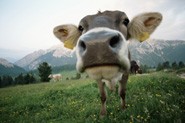
Two groups of cows were fed on different diets and then their methane production and faecal archaeol concentration were measured. The animals that were allowed to graze on as much silage as they wanted emitted significantly more methane and produced faeces with higher concentrations of archaeol than those given a fixed amount of silage, supplemented by concentrate feed. This confirms that manipulating the diet of domestic livestock could also be an important way of controlling methane gas emissions.
Scientists could have a revolutionary new way of measuring how much of the potent greenhouse gas methane is produced by cows and other ruminants, thanks to a surprising discovery in their excrement. Researchers from the University of Bristol and the Teagasc Animal and Grassland Research Centre in Ireland, have found a link between methane production and levels of a compound called archaeol in the faeces of several fore-gut fermenting animals including cows, sheep and deer. The compound could potentially be developed as a biomarker to estimate the methane production from domestic and wild animals, allowing scientists to more accurately assess the contribution that ruminants make to global greenhouse gas emissions. Co-author Dr Fiona Gill, who conducted the work as a postdoctoral researcher at Bristol and is now at the University of Leeds , said: 'When it comes to calculating carbon budgets there is currently a lot of uncertainty surrounding animal methane contributions, particularly from wild ruminants. 'We're quite good at measuring man-made CO2 emissions, but techniques to measure the animal production of methane - a much more potent greenhouse gas - have serious limitations. 'If we can identify a simple biomarker for methane production in animal stools, then we can use this along with information on diet and animal population numbers to estimate their total contribution to global methane levels.' Cows, sheep and other ruminants are thought to be responsible for around one-fifth of global methane production but the precise amount has proved difficult to quantify.
TO READ THIS ARTICLE, CREATE YOUR ACCOUNT
And extend your reading, free of charge and with no commitment.