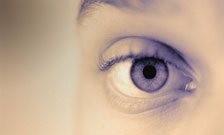
A human eye
Scientists at King's College London have discovered specific cells responsible for ensuring that different parts of the eye come together during development, according to a paper published . These findings significantly enhance understanding of how the different components of the eye are organised into a functional organ, and therefore reveal clues as to the possible causes of congenital malformations that lead to life-long visual impairment. The vertebrate eye contains many different components and has a complex anatomy. At the back of the eye is the retina, which contains neurons and photoreceptors that capture the light and convert it into electrical pulses transmitted to the brain, as well as the pigment epithelium that helps to nourish the retina. In the front of the eye, behind the cornea and iris, lies the lens, which is responsible for focusing the light onto the retina. The correct arrangement of the different parts is critical for normal vision. During development the lens and the retina come from completely different tissues, the surface ectoderm and central nervous system, respectively, which raises the question of how they are aligned to form a functional eye.
TO READ THIS ARTICLE, CREATE YOUR ACCOUNT
And extend your reading, free of charge and with no commitment.