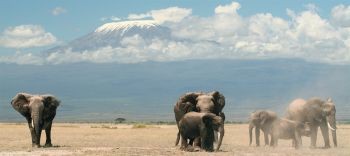
Elephants in Amboseli National Park. Image: Graeme Shannon
How female wisdom in old age helps elephants survive. The value of mature female experience may be something that human society needs to be reminded of from time to time but elephants, it seems, have good reason never to forget. Experiments conducted by University of Sussex behavioural ecologists Dr Karen McComb and Dr Graeme Shannon among the wild African elephants of Amboseli National Park in Kenya show how elephant groups are guided by the wisdom of a female leader or matriarch, accrued through a long lifetime of experience. The older and more experienced the matriarch, the researchers found, the more attuned she was to potential danger to the group, and the better able to distinguish between higher and lower levels of threat posed by predators. The findings of the experiment are published today (Wednesday 16 March) in the journal Proceedings of the Royal Society B . The research team used novel experiments to determine how good elephants were at making crucial decisions about predators - playing back recorded lion roars to family groups (related females and young led by the matriarch) and monitoring their reactions. While elephants are relatively impregnable to most predators due to their size and aggressive group defence, male lions present a very real threat.
TO READ THIS ARTICLE, CREATE YOUR ACCOUNT
And extend your reading, free of charge and with no commitment.