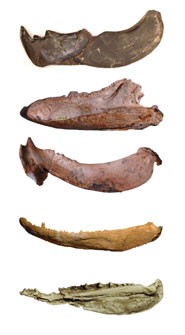
Surprisingly, our results indicate that long-held assumptions concerning the replacement of jawless fishes by newly evolved jawed forms are likely wrong. The variety of feeding mechanisms in early jawed animals appears to have had little to no affect on the diversity of jawless fishes, which shared ecological space with the jawed fishes for at least 30 million years before beginning to notably decline.
With the evolution of jaws some 420 million years ago, jawed animals diversified rapidly into a range of niches that remained stable for the following 80 million years, despite extinctions, habitat loss and competition, say researchers from the Universities of Bristol, Oxford and Leiden in the leading scientific journal Nature. More than 99 per cent of modern vertebrates (animals with a backbone, including humans) have jaws, yet 420 million years ago, jawless, toothless armour-plated fishes dominated the seas, lakes, and rivers. There were no vertebrates yet on land and the recently evolved jawed fishes were minor players in this alien world, some sporting unusual jaw shapes and structures that bear little physical resemblance to modern animals. The researchers, led by Philip Anderson of Bristol's School of Earth Sciences , applied concepts from physics and engineering to unravel the potential feeding functions of these unusual, early vertebrate jaw designs, and compared this data to patterns of diversity in both jawed and jawless fishes. While it has long been assumed that jawed fishes were better adapted, and therefore directly out-competed and replaced their jawless neighbours during this tumultuous time, this assertion has never been tested. Anderson said: 'Surprisingly, our results indicate that long-held assumptions concerning the replacement of jawless fishes by newly evolved jawed forms are likely wrong. The variety of feeding mechanisms in early jawed animals appears to have had little to no affect on the diversity of jawless fishes, which shared ecological space with the jawed fishes for at least 30 million years before beginning to notably decline.
TO READ THIS ARTICLE, CREATE YOUR ACCOUNT
And extend your reading, free of charge and with no commitment.