


news 2011
Chemistry
Results 41 - 52 of 52.
Health - Chemistry - 28.03.2011
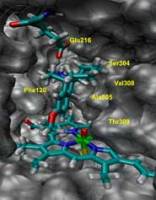
A new discovery about how molecules are broken down by the body, which will help pharmaceutical chemists design better drugs, has been made by researchers at the University of Bristol. Working with Professor Jeremy Harvey and Professor Adrian Mulholland of Bristol's School of Chemistry , Dr Julianna Olah, an EU Marie Curie Fellow in Bristol at the time, studied a class of enzymes ' cytochromes P450 - which play an important role in removing drug molecules from the body.
Chemistry - Life Sciences - 23.03.2011

The organic compounds surviving in fifty million year old fossilized reptile skin can be seen for the first time today, thanks to a stunning infra-red image produced by University of Manchester palaeontologists and geochemists. Published in the journal Royal Society Proceedings B , the brightly-coloured image shows the presence of amides - the organic compounds, or building blocks of life - in the ancient skin of a reptile, found in the 50 million year-old rocks of the Green River Formation in Utah, USA.
Health - Chemistry - 17.03.2011
Scientists create test to track global spread of antibiotic resistance
Scientists at the University of Birmingham have developed a molecular test that has tracked the global spread of a carrier of antibiotic resistance, according to a paper published online today by a leading medical journal. Researchers led by Professor Laura Piddock in the School of Immunity and Infection devised a specific test that can identify the carrier, known as a plasmid, and track its progress around the world in both humans and animals in various strains of E. coli.
Chemistry - Physics - 11.03.2011
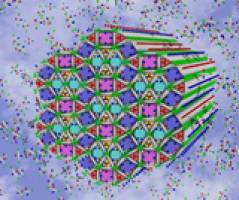
New method for self-assembling molecules Researchers at the University of Sheffield have discovered a new way of making small molecules self-assemble into complex nanopatterns, which will push the limits of what is possible in `bottom-up´ methods of nanopatterning for advanced functional materials through molecular self-assembly.
Chemistry - Health - 08.03.2011
Scientists identify cell component involved in triggering cat allergy
PA 73/11 A breakthrough by scientists at The University of Nottingham could provide hope for any allergy sufferers who have ever had to choose between their health and their household pet. The team of immunologists led by Drs Ghaem-Maghami and Martinez-Pomares in the University's School of Molecular Medical Sciences, and funded by the charity Asthma UK, have identified a cell component which plays a key role in triggering allergic responses to cat dander.
Life Sciences - Chemistry - 01.03.2011
Solving the riddle of nature’s perfect spring
Scientists have unravelled the shape of the protein that gives human tissues their elastic properties in what could lead to the development of new synthetic elastic polymers. University of Manchester researchers, working with colleagues in Australia and the United States, used state-of-the-art techniques to reveal the structure of tropoelastin, the main component of elastin.
Physics - Chemistry - 16.02.2011

An international team of astronomers have identified a thick stellar disc in the Andromeda galaxy, which will help them to understand more about how our own Milky Way and other galaxies evolved. The University of Cambridge-led study involved researchers from the UK, US and Europe, and marks the first time that the "thick disc" in Andromeda, which contains old stars, has been identified.
Chemistry - 07.02.2011
Gallery: Two charges more chemistry
Dr Stephen Price (UCL Chemistry) is part of a UCL team that has developed a piece of experimental apparatus to study the chemistry of dications: molecules that have two positive charges. Recent studies of the layers at the top of the atmospheres of Earth, Mars, Venus and Titan have proposed that such doubly?charged molecules are present in significant numbers and that the chemistry of these energetic species affects the composition of these atmospheric regions.
Health - Chemistry - 21.01.2011
Cell binding discovery brings hope to those with skin and heart problems
A University of Manchester scientist has revealed the mechanism that binds skin cells tightly together, which he believes will lead to new treatments for painful and debilitating skin diseases and also lethal heart defects. Professor David Garrod, in the Faculty of Life Sciences, has found that the glue molecules bind only to similar glue molecules on other cells, making a very tough, resilient structure.
Life Sciences - Chemistry - 21.01.2011
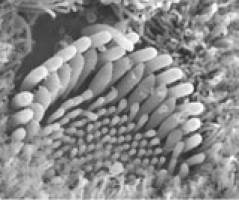
Researchers reveal function of novel molecule that underlies human deafness New research from the University of Sheffield has revealed that the molecular mechanism underlying deafness is caused by a mutation of a specific microRNA called miR-96. The discovery could provide the basis for treating progressive hearing loss and deafness.
Chemistry - Life Sciences - 10.01.2011
Shape-shifting sugars pinned down
Science 10 Jan 11 Oxford University scientists have solved a 50-year-old puzzle about how, why or indeed if, sugar molecules change their shape. Sugar molecules have long been known to adopt chemically unusual shapes but some scientists attributed this to the presence and influence of water or other substances.
Physics - Chemistry - 05.01.2011

Remnants of the first stars have helped astronomers get closer to unlocking the "dark ages" of the cosmos. A team of researchers from the University of Cambridge and California Institute of Technology are using light emitted from massive black holes called quasars to "light up" gases released by the early stars, which exploded billions of years ago.


