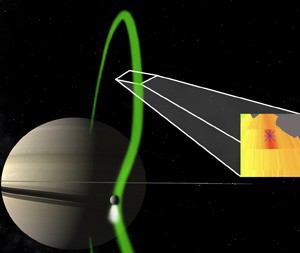
A beam of electrons linking Saturn and
Enceladus. The green line provides an approximate trace of the
magnetic field lines connecting Saturn’s ionosphere with Enceladus
and its south polar plume of gas and icy grains. The inset shows
the electron beam viewed by CAPS-ELS during Cassini’s encounter with
Enceladus on October 31st, 2008. The centering of the electron
beam on the position of the magnetic field (asterix) indicates that the
electrons are flowing parallel to the local magnetic field. Credit: Geraint Jones, UCL
Data from NASA's Cassini spacecraft have revealed that Enceladus, one of Saturn's diminutive moons, is linked to Saturn by powerful electrical currents - beams of electrons that flow back and forth between the planet and moon. The finding is part of a paper published in Nature today. CAPS, one of the instruments on board Cassini which made the electron beam discovery, includes a electron sensor called CAPS-ELS - led by UCL (University College London). Since Cassini's arrival at Saturn in 2004 it has passed 500km-wide Enceladus 14 times, gradually discovering more of its secrets on each visit. Research has found that jets of gas and icy grains emanate from the south pole of Enceladus, which become electrically charged and form an ionosphere. The motion of Enceladus and its ionosphere through the magnetic bubble that surrounds Saturn acts like a dynamo, setting up the newly-discovered current system. Scientists already knew that the giant planet Jupiter is linked to three of its moons by charged current systems set up by the satellites orbiting inside its giant magnetic bubble, the magnetosphere, and that these current systems form glowing spots in the planet's upper atmosphere.
TO READ THIS ARTICLE, CREATE YOUR ACCOUNT
And extend your reading, free of charge and with no commitment.