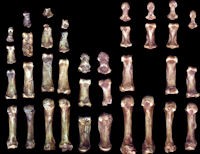
Fossilised hands of an early modern human (left) and Neanderthal (right). Image courtesy of E. Trinkaus and the Israel Antiquities Authority.
Liverpool, UK - 3 November 2010: Fossil finger bones of early human ancestors suggest that Neanderthals were more promiscuous than human populations today, researchers at the universities of Liverpool and Oxford have found. Scientists, in collaboration with researchers at the universities of Southampton and Calgary, used finger ratios from fossilised skeletal remains of early apes and extinct hominins, as indicators of the levels of exposure species had to prenatal androgens - a group of hormones that is important in the development of masculine characteristics such as aggression and promiscuity. It is thought that androgens, such as testosterone, affect finger length during development in the womb. High levels of the hormones increase the length of the fourth finger in comparison to the second finger, resulting in a low index to ring finger ratio. Researchers analysed the fossil finger bone ratios of Neanderthals and early apes, as well as hominins, Ardipithecus ramidus and Australopithecus afarensis, to further understanding of their social behaviour. The team found that the fossil finger ratios of Neanderthals, and early members of the human species, were lower than most living humans, which suggests that they had been exposed to high levels of prenatal androgens. This indicates that early humans were likely to be more competitive and promiscuous than people today.
TO READ THIS ARTICLE, CREATE YOUR ACCOUNT
And extend your reading, free of charge and with no commitment.