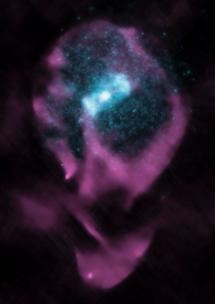
The Circinus X-1 system, with X-rays shown in blue and radio waves in purple. The purple radio nebula is thought to be the remnant of a supernova 4,600 years ago.
The youngest pair of stars to emerge from a supernova, dancing around each other as the neutron star cannibalises its partner, have been identified by an international collaboration involving Professor Rob Fender of Oxford University. The pair began life as giant stars peacefully orbiting each other, one slightly heavier than its companion. Over time, the heavier star became unstable and around 4,600 years ago it went supernova, collapsing under its own gravity in a huge explosion. In most cases, the force of the explosion sends the companion star hurtling through space, breaking the pair up - but not in this system, called Circinus X-1. 'The companion star probably absorbed a lot of the material from the larger star before the explosion, growing into a supergiant so heavy that it was barely moved by the blast,' said Professor Fender of Oxford University's Department of Physics, co-author of the latest study. 'Meanwhile, the supernova forced the remains of the larger star, around the mass of two suns, into a super-dense neutron star no bigger than a city. 'This is an incredibly rare scenario, and we've never seen a system like this so soon after supernova before - 4,600 years might not sound too young, but we're talking about systems that typically take millions of years to mature.' [Click image at bottom of article to see how the system evolved.
TO READ THIS ARTICLE, CREATE YOUR ACCOUNT
And extend your reading, free of charge and with no commitment.