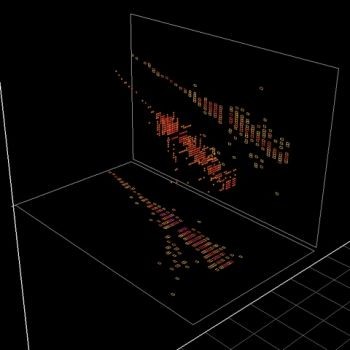
This 3D image shows a cosmic-ray muon producing a large shower of energy as it passes through the NOvA far detector in Minnesota. Image courtesy NOvA collaboration.
Physicists visit neutrino experiment site. Physicists from the University of Sussex are in the USA this month helping to set up the largest-ever experiment into neutrinos to be built there, just weeks after its neutrino detector, which is still under construction, recorded its first three-dimensional images of particles. Using the first completed section of the $200 million NOvA neutrino detector, scientists have begun collecting data from cosmic rays - particles produced by a constant rain of atomic nuclei falling on the Earth's atmosphere from space. A Sussex team, led by Dr Jeff Hartnell, will join scientists from around the world at the NOvA experiment's headquarters near Chicago from 18 to 21 April for a collaboration meeting with some of the 180 scientists and engineers who are taking part. The NOvA experiment, an international research project, is investigating fundamental issues about the universe and our existence, such as why there is more matter than antimatter. Scientists' goal for the completed detector is to use it to discover properties of mysterious fundamental particles called neutrinos. Neutrinos are as abundant as cosmic rays in the atmosphere, but they have barely any mass and interact much more rarely with other matter.
TO READ THIS ARTICLE, CREATE YOUR ACCOUNT
And extend your reading, free of charge and with no commitment.